Showing posts with label military. Show all posts

Friday, November 21, 2025

Russia's Ground Game Not Keeping Up With Its Propaganda

Those of you who've been following Russia in the last few years of its >11.5 year war to seize Ukraine will be interested that its neighboring dictatorship in North Korea, which has been providing the lion's share of Putin's artillery shells, may be running out of ammunition it can spare to sell. Despite shipping 6.5 million artillery shells to Russia since it began arming its former supplier,  North Korea's 2025 shipments appear to be approximately half its 2024 shipments, and observers in September of 2025 were unable to identify even a single shipment of artillery shells from North Korea. It hasn't helped that the quality of North Korea's ammunition products has been worse even than the quality of Russia's.

Russia's economy has been suffering, its population has been in decline since before it started stealing Ukrainian children, its casualties exceed 1.1 million (larger than its active military), and recruiting is so bad Russia has been sending its underperforming recruiting officers to frontline deployment in Ukraine to die. Soviet-era stockpiles of ammunition and armored vehicles have been exhausted. Funding Putin's war with oil exports has faced multiple headwinds, ranging from economic sanctions to deep-Russia attacks on petroleum infrastructure that reduces production, interferes with transport, eliminates significant elements of Russia's refining capacity (video: a petroleum distillation column struck), and destroys Russian export facilities (like this one on the Black Sea). Just keeping its facilities operating is a challenge, seriously draining margins and preventing altogether the export of refined petroleum products, with which Russia is struggling to adequately supply military units who increasingly are deployed in meat waves unsupported by armor. In prior years, "missing" soldiers' families were not paid death benefits that Russian law provided for soldiers' families, but it's gotten worse: live workers who can still complain, and who can be found alive in Russia, are increasingly not being paid for work done to keep Russia's economy alive. (Forty-four percent of construction wages are reportedly not being paid, for example, and other industries are suffering wage nonpayment not only in the private sector but for government employees.)

Russia's 11.5-year war appears to have stabilized as a grinding war of attrition, which Russia has always assumed works in its favor. Yet in this time Russia manages to control approximately 20% of Ukraine's surface, most of which was taken in its 2014 surprise offensive supported by corrupted officers in the Soviet-trained legacy military stationed in the affected areas of Ukraine. The last couple of years, Russia's gains amount to approximately 1% and it has exacted from Russia an enormous cost in blood, matériel, and treasure. Although Russia postures over the destruction of little towns that used to house 10,000 civilians before they fled, the fact on the ground is that what Russia has been touting as gains have come at an enormous cost.

St. Petersburg's crematorium has been expanded to handle 250 bodies per day, and that's a city from which Russia has deliberately avoided recruiting in order to keep unrest from the two urban centers that differentiate Russia, at least cosmetically, from third-world countries (the other being Moscow).

Monday, October 28, 2024

Russia Cannot Afford Putin's Ambitions

The Jaded Consumer doesn't want to amplify economic nonsense by linking to it, but the international news sources that uncritically publish economic numbers approved by authoritarian regimes aren't doing the public any favors in understanding the impact of nations' military and economic policies and appreciating the prices caused by their conflicts. This note is intended to provide an evidence-based view of the global conflict underway between expansionist tyrannies and the more democratic nations authoritarians have targeted.

Russia claimed to have bulletproofed itself against sanctions in order to enjoy normalcy as it prosecutes ongoing war against Ukraine. Claims that Russia thrives while democratic adversaries suffer economically are undermined greatly by the data. Russia's central bank's announced interest rate is worse than I've paid on credit cards. At the time of this writing the rate has been raised to 21%. Russian propagandists had been trying to convince democratic nations that imposing sanctions on Russia injured free people more than the subjects of what's left of the Russian empire. The claim Russia's economy is strong has two basic problems. First, Russia's auto industry is now wholly dependent on manufactured goods from China, and Russians buy these with funds obtained selling raw materials to China (primarily unrefined energy products). If acting as a source of raw materials while buying finished goods from one's sponsor state sounds to you like the role of a colony, you've figured out that Russia is now a de facto colony of China. The second problem is that even suffering the colonization sucks: unlike the U.S., which has got inflation in the low single digits and is close enough to its ultimate target inflation rate that the federal reserve bank is cutting interest rates to avoid allowing inflation to fall too much, Russia still has an official inflation rate that is in the high single-digits (and a real inflation rate estimated at 27%). It might be worse, but a lot of what Russians want to buy isn't available at any price. Whoops.

Russia isn't alone in living in a fantasy land. China has been making public policy on the basis of fictitious population data, and that's going to cost it. The longer China can get cheap fuel from Russia to prop it up from collapse, the longer the West has to reconfigure supply chains so as to avoid dependence on authoritarian regimes and the legal quicksand the tyranny there imposes on all who do business there.

Russia is dependent on North Korea and Iran for weapons and is burning cash while it goes all-in on Putin's dream of re-establishing the lost empire of the Russia of his imagination, with Soviet-era borders. Unless some outsider throws Putin a lifeline, he's going to drive himself and his government into the same kind of bankruptcy-driven collapse that put an end to the Soviet Union. China will just take the eastern territories Russia continues to occupy but hasn't anyone there to defend it. China has already updated its maps of Russian territory with its preferred Chinese names.

Monday, April 29, 2024

Productivity (or not) in Russia

After reading an American business article breathlessly gushing about the supposed strength of Russia's economy, with such details as a high employment rate under 3%, it seems worthwhile to draw attention to facts known about the topic.

More than 40% of the enterprises in Russia – including both civilian business and firms dedicated to military production – are shorthanded. Want to expand your business, or buy a house? The Bank of Russia has set its benchmark rate at 16% and still expects inflation not to fall quickly. A commercial loan isn't going to be made at the bank benchmark rate.

The same article that celebrated Russia's economic "strength" reported that Russia's employment situation benefitted from Russia's "voluntary" military recruitment model. Sure, there are some Russians who signed contracts to kill Ukrainians for $2,000 per month; that's true. But there's also a regularly scheduled conscription system that pulls several hundred thousand young Russians into the military each conscription cycle and, despite Russian law that states conscripts cannot be sent abroad to war, they've been sent to Ukraine from the very start of the war. These hundreds of thousands of men haven't had an easy time of it; Western estimates put the number of dead and wounded over 400,000. Few of them will work normal jobs again. More workers have fled Russia to avoid conscription – the UK Ministry of Defense estimated fleeing Russians numbered 1,300,000 in 2022 alone. Many of the fleeing Russians have been the most employable: young people in technology work who left because it was easy to do their work abroad.

That full-employment picture looks less cheery when one considers how many Russians fled the country or were sent to Ukraine to die, to get Russia to its low unemployment rate. And those who are working are being courted by military supply firms to lure them from economy segments that sustain and improve Russians' quality of life. Inflation is a direct result of military suppliers outbidding civilian employers to satisfy Russia's demand for weapons and ammunition.

When calculating GDP in Russia, translation into dollars is tough: selling rubles for dollars is illegal, so there is no market value for rubles. The rate of exchange for rubles is a government-promulgated fiction. Who knows what it'd be worth.

Russia is still in the war in Ukraine for the simple reason that enemies of the democratic West – primarily China, Iran, and North Korea – are showering Russia with supplies from which to make war materiel. It should be no surprise that Ukraine requires support itself. Like the Cold War ended when Russia bankrupted itself in an arms race against the so-called "Star Wars" (technically the Strategic Defense Initiative) defense programs, the conflict with fascist dictatorships allied against the West may be won luring them into an escalation of commitment to an unwinnable fight to expand Russia's borders.

And the more Russia embarrasses itself failing to defeat Ukraine, the more Russia's neighbors will be emboldened to reach out to make alliances with the capacity to support them in improving their quality of life.

Wednesday, January 31, 2024

Russia Handling Sanctions Worse Than It Pretends

 The cost of shipping energy products to more distant customers, the loss of workers to frontline duty and to international flight, and the inability to tap foreign resources to support local operations have left Russia in an economic crisis that its propaganda efforts and international denials cannot hide. The price of eggs increased 18% last month (December 2023) in that one month alone. The Russian Federation has been propping up the economy by directing long-husbanded resources into military-oriented manufacturing, but causing an explosion in Ukraine does nothing for quality of life within Russia; the transformation of Russia into a wartime economy currently directs a third of the federation's national expenditures into the military

While Putin claims in his speeches that Russia's economy thrives despite foreign barriers to trade with most of the free world, much of the nation's current production does nothing for Russians: rockets aren't infrastructure, they destroy infrastructure. This game of economic chicken is profitable only if Russia ultimately seizes Ukraine and its natural resources and can compel the service of its millions of inhabitants. Forcing people to serve Russia's tyrants isn't a particularly efficient way to build national wealth, but it's all tyrants know. And they're used to the inefficiency: per-capita GDP within the Russia's empire is so small that despite having many times the population of Texas, the empire's overall GDP was lower even before sanctions cost Russia all the foreign expertise that had kept its energy industry in business. GDP per capita in Russia has been on par with China, at a fraction of GDPs typical of democracies in Europe or Asia.

If nobody throws the Russian tyranny a lifeline, it will likely digest itself trying to threaten neighbors into surrendering to Russia's appetite for geographic expansion. 

Halting Russia's advances into Ukraine has been an efficient investment for the United States. For only a few percent of the existing US defense budget, the United States has created a state of emergency in its most aggressive international adversary which is spending not just a third of its military budget, but a third of its entire national budget, to hand onto its untenable position. Especially since Ukraine is willing to contribute all the combat personnel, supplying them with equipment to test and improve American tactics and methods against Russia's current best technology and electronic systems is a fantastic investment in the future of our defense of American interests and the interests of democratic trading partners around the world.

Tuesday, May 16, 2023

Russia Over the Long Term

 Much ink has been spilled arguing about the impact of sanctions on Russia using such evidence as the "price" or the Russian rouble or GDP figures that turn on the sales volume of exported energy products, but these metrics don't offer much insight into the strength of Russia's ability to sustain itself while antagonizing the world's democracies with renewed imperialist ambition. (This article won't describe those ambitions; anyone interested in them is well served to read Putin's speeches going back the last few decades to appreciate his longing for the era of Stalin and his hope to return Russia to a similarly feared global power of similar size and international influence.)


What's wrong with looking at the price of the rouble to understand the nation's economic strength? The question one might ask is, whose price? The price available in a free market can hardly be assessed in Russia, where post-invasion law promptly forbade forbade banks and brokers to sell dollars, euros, and other foreign currencies to rouble-paying buyer. If you can't sell roubles, how do you know its price? Russian gaming of currency didn't end there, either. Despite having long-term contracts that required Russia to supply energy products to foreign buyers in currencies such as the euro, yen, or dollar, Putin declared that all purchases would be made in Russian roubles or not at all. Basically Putin declared the power to unilaterally change contract terms at a whim and held energy products hostage to enforce it. The upshot is that nobody knows what the rouble is worth in a free market because there is no free market in roubles after Russia's invasion of Ukraine. Nobody who wants to bail out of roubles can. Indeed, nobody who wants to bail out of Russian assets can: foreigners can't sell stock on Russia's exchanges, they can't sell their interests in Russian energy programs, and they can't liquidate any proceeds they do have in local currency in order to leave with their own currency.

Russia simply seized Western investment. Since nobody will be selling it for foreign currency, the "market" in Russian assets, firms, and currency will not depict the exodus.

What will?

Production.

A look at Russia's production of domestic cars yields some insight into the effect of Russia's policies on Russia's ability to produce passenger cars. The year ending March 2023 shows Russia's automotive production suffering a short-term near-halt, with eventual recovery to about one third of the nation's pre-invasion:

Automobiles don't really show the whole range of Russian production capability, but consider the non-mobilized population of Russia and its interest in normal life. With foreign auto makers bailing out of Russian production partnerships and halting export to Russia, Russians face the alternatives of domestic production or imports from Chinese firms which Russians historically avoided. Although Russian auto sales plummeted over 60%, Chinese share of those sales more than tripled to nearly a third of Russia's ailing auto market. Soviet-era auto brand revivals feature Chinese designs and key components.

As interesting as the evolution of seized foreign plants into Russian production centers may be, the story of Russia's consumer vehicle market isn't the story of Russian GDP. Consider something closer to the priorities of Putin's war machine: trucks required to support war logistics. Russia actually needs trucks to re-establish the empire Putin imagines in his fantasies. Trucks have a certain priority. Before Russia's invasion, a February 2022 estimate foresaw Russia's commercial vehicle market growing at over 3% per year through 2028 on the strength of joint ventures with foreign firms bringing their expertise to the Russian market. The dislocations described above killed growth in Russian commercial vehicle production just as the war in Ukraine destroyed thousands of trucks driven by Russia to lose in Ukraine:


Outside the realm of trucks, Russians find themselves relying on suddenly slower, costlier, and more tenuous supply lines for foreign goods ranging from perishable food items to teabag paper.

Given that Russia now apparently depends on China for its domestic supply of automobiles and trucks, one must ask where Russia is getting the money to pay China for the exported parts. Here, at least, there is no mystery: exported raw goods, primarily in the form of energy products. With the departure of experienced foreign operators, Russia's gas production has already fallen 10% in the last year. Gas is kind of a problem, because its existing pipelines to China won't take more volume and Russia lacks the ability to create LNG terminals to shift gas production to export by ship. Making big capital investments isn't really the style of the Russian empire: it expects others to make the investments on which it depends. By contrast, Russia's oil exports have declined only slightly since its invasion of Ukraine:
Russia is selling all the oil it can to the closest buyers it can manage, because each round trip with an oil transport ship to Europe took something like one week whereas it can take months one-way to India. There's not enough ships to handle all Russia's export if Russia ships oil to India, and Europe has slammed the door on it. It turns out that China is close. And it doesn't matter so much what currency China pays for oil, as Russia must immediately pay Chinese firms that same currency to buy the auto parts, computer chips, cell phones, automobiles, drones, communications equipment, food, and everything else Russia imports from China. 

By reducing itself to a raw good supplier and a finished goods buyer, Russia has remade itself into, in effect, a colony. China, recognizing this, has approved a new map model that renames Russian border cities with old Chinese names (e.g., Vladivostok swapped for Sea Cucumber Bay ("Khaishenvai")), and is already publishing the new maps. Border territories are also renamed. Xi does to Putin what Putin does to former Soviet republics: he's reneging on border-fixing deals Yeltzin made in the '90s. 

Putin can hardly object: he's rendered Russia so wholly dependent on Chinese matériel and funds that he's got to accept what China offers. A Chinese-speaking informant who saw Putin appearing with Chinese officials noted that the Chinese translation of Putin's remarks appeared to suggest the entire speech had been written by the Chinese, as the Chinese text veritably drips with language of a vassal addressing his emperor. Putin either accepted this, or he's an oblivious fool. And it doesn't matter which: he's helpless. Russia no longer poses a credible threat of projected military power. China will enjoy this for a while, no doubt, observing the developments in Ukraine, before taking action. However, Russia will have no practical ability to oppose China when China starts changing street names and flags in former Soviet lands that interest Xi. 

As Russian population has failed to keep Russian resources productively employed, Chinese have taken over former Soviet farms and now own and live on land in Russia. There aren't a lot of ethnic Russians in the eastern reaches of what is left of Russia's empire, so the takeover is already well underway. Putin's Russia endures like a frog in a heating pot: at the sufferance of a chef who's already got the rest of the dinner cooking.


Friday, June 3, 2022

Putin's 3-Day War: Day 100

One hundred days into Putin's 3-day war to capture Ukraine for re-integration into the Russian empire, things are not going well for anyone. Blockade of Ukraine's ports is starving Africa. Ukrainian sources estimated Russian tank losses at 1000 units some weeks ago. During the last week of May 2022, U.S. intelligence sources assessed that Putin's invading force had lost a thousand tanks. Part of Russia's disasterous performance comes down to Russian decisions to ignore Russian doctrine and take risks assaulting with armor ahead of infantry protection. In what was perhaps its worst engagement so far, Russians were allowed to slowly assemble multimillion-dollar segments of a pontoon bridge and begin crossing a key river with armor before prepared Ukrainians obliterated scores of vehicles and apparently an entire division of Russian forces.

Thursday, April 7, 2022

Cannot Remain In Power: What That Means Without Any NATO Attack

Information Gap

If Putin's rule could survive Russians learning what its government was doing at Putin's instructions, Putin would not have suddenly changed the law to prevent Russians calling his invading Ukraine a "war" and closed all the independent news outlets in Russia. He knows his rule depends on misleading Russians. It's a lesson he learned while in the KGB, helping to mislead Russian and East German workers whose output was captured for the benefit of the regimes' political elites. Putin may have been deceived by Soviet propaganda about Russia's history, but he certainly understood his government employers did not try in any way to deliver Russians communism – ordinary Russians didn't control the means of production in Russia, did not choose how Russian resources would be allocated, and were prevented from achieving reform by farce elections that existed only for propaganda purposes (anyone operating a reform party was killed or incarcerated). Putin knew Russia's government existed for the benefit of its political elite, and he's worked to become the head of that political elite and to restore what he regards as the tragically lost glory of Stalin's Soviet empire.

Putin's miserly grip on true facts is killing Russians. Consider the soldiers who had no knowledge of the history of Chernobyl – why would Putin-authorized schools and media allow information about Russians causing the world's most notorious and nasty nuclear disaster? Ordered to seize Chernobyl with no forewarning of its dangers, soldiers not only stirred up radioactive dust driving vehicles through danger zones but dug trenches in areas so toxic facility oversight workers were forbidden even to go there. The deaths aren't all over-the-horizon horrors of dying slowly at home in a later year: in the first month Putin has gotten as much as 25% of his entire invasion force killed. This is a direct result of what onlookers have noted as a surprising inability to execute combined arms: Putin's armor has advanced without infantry support so armored elements could be picked off and destroyed by anti-armor infantry weapons like the NLAW and Javelin (or mines) which have been delivered to Ukraine in quantities that significantly outnumber Putin's entire inventory of tanks; advancing infantry has consistently lacked close air support; artillery hasn't supported armor; in essence, each of Putin's infantry, armor, artillery, and air units have been acting in relative isolation, and without the coordination required to execute military maneuvers at the skill and effectiveness NATO forces have trained to achieve. Putin's police state, apparently assuming that its information campaigns and not its huge numbers of troops have allowed it to swallow tiny opponents, grievously misunderstood the nature of the conflict it started in Ukraine.

The death toll isn't a diversion from the discussion of information, but a consequence of Putin's iron-fisted control over the distribution of facts. A Western military conducting a ground assault would empower a local officer to receive intelligence from every available source so that commands could be given across all military branches to achieve a joint mission intelligently integrating armor, artillery, bombing operations, infantry, close air support, and intelligence. Imagine for a moment how long Putin would last in office if some office other than his own had such broad access to information and military command. Would he last a week? The fact Western militaries do this all the time without governments collapsing in a coup shows that Western governments have the support of their people: they possess what in a democracy passes for legitimacy, which is broad popular support. Putin does not. In a Putinesque government, legitimacy is the fact of rule as maintained by bribe or threat and nothing more.

Putin can't let local commanders coordinate or he'd be out of a job and he knows it. Putin can't give his commanders the ability to perform like Western forces. This isn't something Putin can learn from: this is a fundamental flaw in Putin's entire style of government.

Ukrainian Capabilities

From the outset, Ukrainian civilians have opposed Russian invadersrefusing to collaborate with invaders (for which some were murdered), and poisoning occupiers. The crimes committed against Ukrainians have galvanized them against Russia. The enormous catalog of photos available online of Russian armor standing in a derelict shambles in Ukraine proves Ukraine is willing to engage Russia's armor, and the fact Ukraine has retaken towns Russia formerly occupied proves that it is capable of succeeding in offense against Russian infantry. The scores of Russian aircraft lost so far demonstrate it can do what Afghans did for more than nine years of occupation and make air operations a sphincter-puckering experience for Russians.

Russian claims about its destruction of Ukrainian personnel and equipment are pretty easily debunked: had Putin's forces obliterated more than 50% of Ukraine's inventory of tanks or artillery,  Ukraine's military would no longer be an effective fighting force. Yet, it's Russian forces in retreat. While Russia has managed to capture several small military watercraft, it's lost a landing craft and suffered damage to another landing craft and a patrol boat. Out of the water, the tables are turned: Ukraine has destroyed at least 62 Russian aircraft, the number Oryx has been independently able to verify through photographic evidence, while losing 30. Oryx has confirmed Russia's loss of 2608 ground vehicles including 448 tanks, of which 182 have been captured by Ukraine and turned against Putin; Oryx has confirmed Ukraine has lost 697 vehicles, including 95 tanks. This means Ukraine's tank count may have actually increased since the start of the invasion as its forces have captured from Putin more tanks than it has lost in battle. Other sources make Russia's losses to Ukraine look much grimmer: since Russia is unable to field precision munitions, the only way its aircraft can hit anything on the ground is to make a bombing run that is low enough for visual targeting, which drives planes directly into the teeth of the air defense Russians have no hope to suppress – man-portable anti-air rockets of the kind NATO countries have been showering Ukraine. Three weeks into the war Ukraine was claiming 77 aircraft kills, and the New York Times radio intercepts included numerous ignored pleas by a Russian armor radioman for close air support that never came. Russians can't do what they want with air.

Russians may be able to murder Ukrainian civilians at will, but they've been unable to defeat Ukraine's military forces anywhere. Citing Ukrainian sources, Pravda reports Ukraine has killed 16,600 invading Russian soldiers, a number greater than Russia's losses over several years in Chechnya or even its nine-plus-year campaign in Afghanistan.

Putin's Ambitions

Anyone who has been watching understood Putin planned to take the rest of Ukraine after he ordered it partially seized in 2014. His blatant invasion lacks the middle-of-the-night quietness of salami-slicing border encroachment committed by prior regimes, by China into India, or even by Putin into Georgia. Aggression hasn't worked out for Putin in the 2022 invasion of Ukraine: within the first two weeks Putin lost up to 10% of his combat forces – the very definition of "decimation."

Since Putin committed Russia's entire deployable force, there's nothing with which he can quickly reinforce troops he sacrificed to wood chipper that is Ukraine. Accordingly, Putin has been scraping to find soldiers he can re-allocate from occupation of Georgia (which Putin invaded in 2008), mercenaries from Syria and Putin's advertising campaigns targeted at Russians who have previously murdered civilians abroad, and a tyrant enthusiasts from war-ridden places like Chechnya. Putin's pleas for Belarusian soldiers have not met with success: Belarus' dictator owes his office to Putin's intervention, but Belarusians are dissatisfied with his sham elections, and Belarusians are undermining their dictator's effort to support Putin's war in Ukraine. Putin's work to keep Belarus under the boot of a puppet dictator has, in fact, made Belarusians enter Ukraine to kill Russians. Foreign volunteers motivated to defend against Putin for free might not actually reach the reported 20,000, but even so may dwarf the number Russia has been able to hire or import. One of the major foreign fighter groups in Ukraine is the Georgian Legion, which since 2014 has been striking back at the dictator who invaded their homeland; they're training other foreigners (including many from English-speaking countries). Since 2016 the legion has swelled from about one hundred fighters to hundreds of applications per day.

Putin's biggest enemy may be the shocking incompetence of his own regime. His army can't manage to get a column of vehicles to Kyiv on a paved road. The missiles he's firing into Ukraine have a fail rate approaching 60%. And he's not going to make it up in volume: he seems to be running out of inventory (other arguments here). The fact he wasn't ready for the war he started has been something of a shock to observers. Forces sent to capture Kyiv included elite Russian units like the now-decimated 331st Guards Parachute Regiment. Decisions to staff logistical roles with conscripts who haven't been on job even a single year hasn't helped keep Russian invaders supplied with food or armaments. Although Putin has just ordered another 134,500 men to be conscripted into the Russian army, they won't be of much help until trained. Also, deploying conscripts in a foreign war violates Russian law, and Putin's own claims, though he has been contradicted by Russian military sources who confirm Russia indeed ordered conscripts deployed to war to Putin's "special military operation" in Ukraine. The domestic effect of this news is severe enough that Putin made a public announcement ordering military prosecutors to identify and bring charges against those who sent conscripts into Ukraine in his invasion's first phase. Putin claims that these conscripts won't be sent to Ukraine, but time will prove him a liar as the vanishing Russian soldiers begin contradicting Putin's propaganda that everything is going to plan.

Apparently, part of the plan is shoddy equipment. Instead of military-grade communications with encryption, Russian soldiers have been found using unencrypted off-the shelf handheld walkie-talkies from budget Chinese manufacturers. Accordingly, their disorganization and panic can be heard on open channels, as captured by The New York Times. Russians' discussion of their own war crimes can be captured by German intelligence services. 

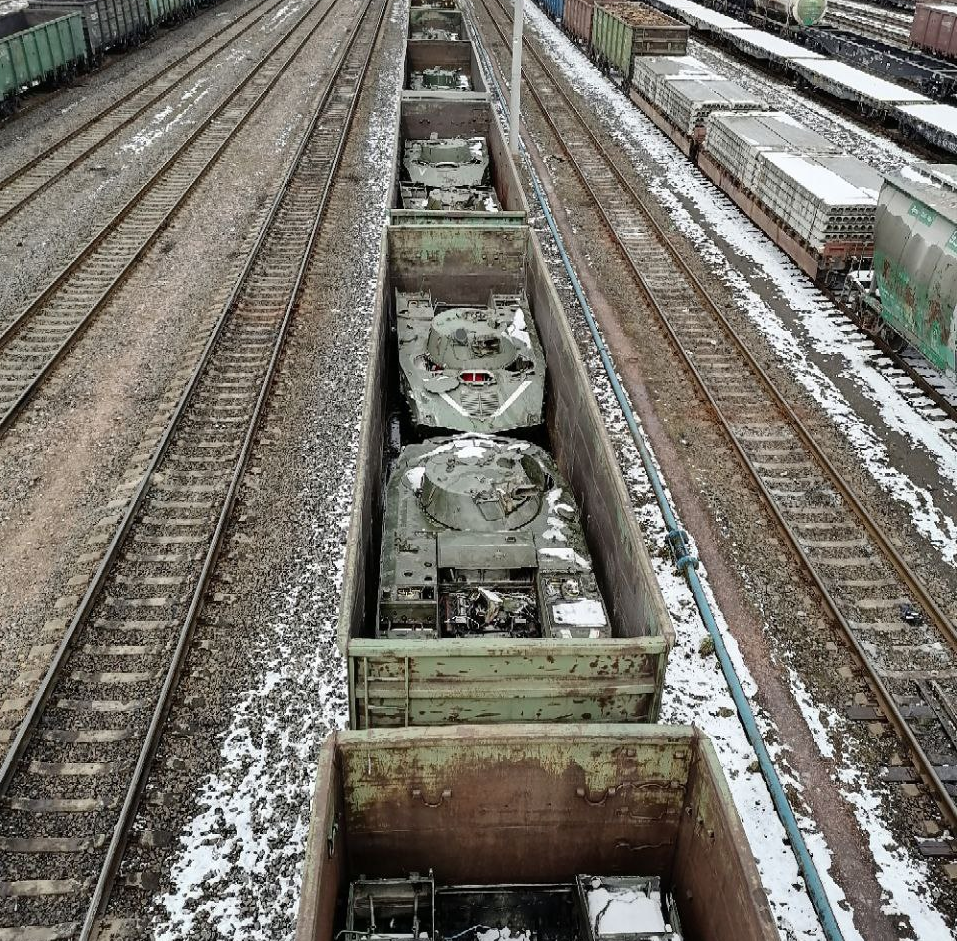
Considering the huge trove of photographs showing Russian armored personnel carriers and tanks destroyed in every corner of Ukraine, it's hard to see how Russia can sustain war while it can't build more military equipment. Check out this image, showing Russia removing from Ukraine the scrapped husks of destroyed Russian armor:


Looking at this photo casts in a new light all the photos shown of Russian armor rusting by a roadside or laying upside down or standing in a roadway with the turret blown free of the body: how many more of those we'd see if Russia had been able to spirit away more of the physical evidence.

Speaking of evidence, Putin's propaganda that Russians are carefully targeting exclusively military targets while providing humanitarian assistance to locals has been undermined by drone and satellite footage showing Russian forces slaughtering fleeing motorists, murdering bicyclists, shooting civilians in a bread line, and Russians killed civilians and left their corpses on the street before Ukrainians could possibly have created a staged scene. Russians killed and wounded civilians indiscriminately while committing an airstrike against a maternity hospital in Mariupol, which is not an isolated incident: Putin's forces have destroyed every single hospital in Chernihiv. By March 26, 2022, Russians had launched more than 70 separate attacks on Ukraine's hospitals and the World Health Organization said the number grew daily. The fact Russian soldiers are robbing civilians during their invasion is proved by the fact Ukrainian survivors can track their robbers' movements as they retreat with stolen Apple devices trackable by their owners. 

Looting expensive consumer tech isn't necessary to Russia's advance, but with Russian logistics in the toilet Russian soldiers have been looting grocery stores and living out of civilian houses and committing other criminal acts against civilians while driven to otherwise avoidable contact. Russia can't supply soldiers. So, it's little wonder all the evil Putin can order has failed to take Ukraine. It has, instead, galvanized against Russia virtually everyone capable of receiving uncensored news. Germans, who long disdained active military activity beyond their borders and resisted spending on defense what NATO encourages its members to spend, have escalated from sending Ukraine non-lethal aid like helmets to sending antitank and antiaircraft missiles while bumping defense spending above NATO's recommended 2% threshold. Putin's effort to strangle democracy in neighboring nations – Georgia, Ukraine, Belarus – has driven democracies together.

Sanctions have halted Putin's ability to restore lost force-projection capacity. For example, the two principal factories that make and rebuild Russia's tanks and armored personnel carriers have been shuttered for lack of parts formerly imported from Europe, which is Russia's most leading trading partner. Putin's aircraft lost their source for repair parts. Russia may have the ability to manufacture small arms, but vehicles? Putin had a hard enough time moving soldiers away from a railway when his ability to amass war matériel stood unobstructed. Now his power to project force is gone.

International condemnation isn't mere words: substantial changes in international trade posture has created a long-term and growing problem for Russia, the impact of which is already contracting the Russian economy. To prop up the Rouble with deposits in Russian banks, Putin had Russian banks more than double the interest rate to 20% – but inflation was forecast at 24%, but the White House Economic Council reported April 5 that current inflation in Russia stood at 2% per week or 200% per year. 

Putin wanted to live in the Soviet Union again … and now he does. He'll better understand how the Soviet Union he served through the '80s collapsed in the early '90s by making it happen again under his watch.

He'll throw bodies at this problem – and, like all those sent to their fruitless destruction in Afghanistan, they'll die.


Friday, January 22, 2016

US Air Strategy: Did They think This Through? (Update: Warthog Saved till 2022)

CNN is running an article that says Daesh may have saved the A-10 "Warthog" close-air support (CAS) craft, which flies at slow speed and can linger over battlefields to deliver precision fire on targets too close to friendly forces to employ artillery or guided bombs (e.g., within twenty meters).  For the uninitiated, the A-10 is essentially a Gatling-style cannon with stubby wings, capable of shooting through tanks with depleted-uranium rounds with which it can strafe at 65 rounds per second.  It has a reputation for being extremely resilient to enemy fire (can return to base having lost an engine, or having lost half a wing), and pilots have used its resilience to advantage by, for example, intentionally attracting enemy fire to protect embattled ground forces.  The Warthog protects its pilot with a 1200-pound titanium-armored cockpit, which reduces pilot risk while operating (if needed) below 1,000 feet in altitude – below cloud cover in foul weather or into the teeth of small arms fire, places where other craft tasked with CAS could not or would not venture but Warthogs did.  Defense One reported the Air Force had not planned requesting funds to operate A-10 units when it presented its 2017 to Congress in February of 2016.

The A-10's replacement in the close-air-support role won't even be tested until 2018.  One wonders how the Air Force planned providing CAS between 2016 (when A-10 money would have run out) and 2018 (when the Air Force first learned what further help the F-35 would need to accomplish the CAS mission) before it suddenly noticed ground forces remained in danger from active hostiles. Does Air Force budget brass care if ground forces survive what they prefer to send as a CAS substitute for the proven A-10?

UPDATE: The first week in February, Secretary of Defense Ash Carter confirmed the Air Force would continue to fly, and seek funding for, the A-10 "Warthog" for another six years until 2022.

Thursday, July 9, 2015

American General Notices Putin's Thugocracy A Threat

At least someone's noticing Putin's innocent-faced invasion of its neighbor illustrates the harm he's willing to cause when convenient.  In order to conceal the scope of the wars Putin conducts in secret, he's declared "peacetime" troop deaths a state secret.  Well, of course.  People might notice they're actually at war.

Sunday, April 5, 2015

Iraqi City of Tikrit Freed from Tyranny, Looting Follows

When 20 houses were set on fire, 50 shops looted, and trucks loaded with stolen goods escaped unhindered, an Iraqi official explained: "No plans were made for what to do with the city after it was liberated[.]"  Now, where have we seen that before?


Tuesday, May 14, 2013

Rebels Plea For Aid: Send Forks?

A Syrian rebel appears on a video eating the heart and liver of a felled government soldier.  Questioned by outraged observers of the video, the rebel – whose identity is not masked – defended his snack as revenge for atrocities committed by Assad's vicious regime.  This raises a whole new question regarding the form that should be taken by international aid requested against the oppressive government regime.

The religious overtones of Middle Eastern conflict can't be escaped, even in a civil war as obviously about freedom from government oppression as the conflict in Syria has been. On the video, off-camera supporters are heard shouting "Allahu Akbar!"  I didn't think that meal was Kosher in Islam. Anybody have authority to offer on the matter?

Wednesday, September 12, 2012

Crummy Film Incites Islamists To Murder

(Or did it?)

Americans are fond of quoting the English writer Evelyn Beatrice Hall who, writing under the pseudonym Stephen G. Tallentyre, summarized a viewpoint of Voltaire in the famous line: "I disapprove what you say, but I will defend to the death your right to say it."

And now, Americans are dying again. Is it over free speech, or something else?

Sam Bacile, a self-described Israeli Jew whose $5m film was apparently shown at full length exactly once to a mostly-empty theater in Hollywood, reportedly said "Islam is a cancer, period" when interviewed about the film and the subsequent attacks in Egypt and in Libya. At the time of this writing, Sam Bacile is reportedly in hiding. With respect to the American deaths in the Middle East, he responded "I feel the security system is no good. America should do something about it."

Steve Klein, who consulted on the film, said he'd predicted to Bacile that "you're going to be the next Theo van Gogh." In the wake of the cartoon controversy, great prescience seems unnecessary to have reached Klein's conclusion.

So, what about it?

A film whose purpose is to denounce the world's largest and fastest-growing religion appears to be the very sort of speech in which the First Amendment was designed to keep the government from involving itself as an arbiter of truth or propriety. The fact that we treasure the right to speak freely need not mean we necessarily celebrate crummy film. (Surely YouTube has clips from which the quality of the thing will speak for itself.) In Egypt, where attacks began yesterday, the U.S. embassy said it "condemns the continuing efforts by misguided individuals to hurt the religious feelings of Muslims - as we condemn efforts to offend believers of all religions."

But is this about the film, really?

From the campaign trail, Romney (in a prepared statement) seized on an opportunity to say something related to foreign policy after seemingly neglecting it at the recent Republican Convention:
I'm outraged by the attacks on American diplomatic missions in Libya and Egypt and by the death of an American consulate worker in Benghazi. It's disgraceful that the Obama administration's first response was not to condemn attacks on our diplomatic missions, but to sympathize with those who waged the attacks
Maybe the folks at the Embassy were trying to save their skins by saying something politically correct rather than offering to spill their scarce blood in defense of bad film they'd never seen. Clearly caught flat-footed by events – which were incited by non-government actors, and perpetrated by foreigners, leaving the current administration without a lot of basis for predicting things unless it had advanced intelligence of effort to incite attack – the Obama campaign predictably returned a counter-attack:
We are shocked that, at a time when the United States of America is confronting the tragic death of one of our diplomatic officers in Libya, Governor Romney would choose to launch a political attack.
Really? Shocked? During campaign season?

But back to the topic: a deliberately inflammatory movie was made by people intending to discredit a religion well-known for its inclusion of adherents willing to kill over suspected slights to the religion. Consider the recent failed attempt to have a mentally disabled Christian girl executed for blasphemy by planting burned Koran pages in her possession, and the ensuing death threats aimed at the girl's entire family after the falsity of the charges led to her release; the entire family fled their home for fear of being burned alive within. And they were victims of a false-charge plot. So, what should we think about people who deliberately provoke trigger-happy murderers from the safety of our borders?

In this country, we're allowed to think anything we like about them.

The real question is, what should we do about them.

Something? Nothing?

If makers of the film had screamed falsely about a terrorist bomb on a crowded train platform to incite a fatal stampede, we'd have them for a homicide. But in this country, publishing that major prophets are frauds is simply not an offense. Whether there's any truth in the claim isn't the government's concern. Even the genuineness of publisher's beliefs aren't subject to investigation. They are permitted to say anything they like on politico-religious topics, and it's the job of viewers to accord each publication its proper weight.

In this case, the film played to a mostly empty theater – once. It's fairly clear nobody is being persuaded by anything the film has to say. Rather, the film's most zealous audience is one that never saw the thing at all – they just heard through the grapevine that the film insulted their (presumably cherished) religious figures. There's no risk the film will confuse the public about an important religious truth. There's only a risk the film will incite people who don't believe in the value of free speech.

And that's why the United States must take a clear and firm line on the issue. The United States did not participate in or approve of the publication of this or any other film advocating for or against any religious view. The United States' law that prevents prosecution for films that incite a strong religious response is the very sale law that protects genuine religious adherents from persecution for espousing their most sacred beliefs. The United States condemns in the strongest possible terms murders motivated by hatred of the exercise of nonviolent free speech.

The makers of the movie – funded by supporters sharing a common faith of their own – surely knew they were stirring a hornet's nest. Murderers willing to serve time may pursue the film's authors for years – Salman Rusdie has survived over two decades of death threats – but no-one will be able to guarantee his safety. But there can be absolutely nothing to be gained by trying to accommodate murderers and would-be murders by turning over to their care a taxpaying resident of the United States – and even less to be gained by pretending to agree with their grievances.

And what are those grievances? The disabled Christian girl in whose garbage bag burned Koran pages were planted was guilty of being part of a Christian community that annoyed its majority-Muslim neighbors with the sound of Sunday hymns. The ambassador murdered in Libya was guilty of supporting the revolutionaries that toppled Ghadafi and installed the current government. The actual targets of the supposedly religious violence aren't even the source of the claimed offense: they are political symbols.

And when enemies of free speech carry on a political dispute with violence, they carry on a war. The deep questions for the United States revolve around the targets of this war, its proponents, and the extent to which the United States is willing to be drawn into waging it. The last time the United States was drawn into declaring a murder to be an act of war and responding in kind, it boosted the prestige and the recruiting power of the very enemy it sought to suppress. (Of course, is a real invasion any better than propaganda? Consider the justification given by bin Laden for his fatwa against Americans.) Or did it?

What response is merited now?

Well, it doesn't look like the Libya attack was a reprisal for free speech but a calculated attack by an al Quaida affiliate in response to an al Zawahiri plea for retaliatory murder following earlier militant killings in Libya. The unarmed flag-snatching invasion of the U.S. embassy in Egypt is a stark contrast to the RPG-supported militant attack in Libya. The Egyptian protests may really be inspired by fury the U.S. "permitted" someone to make an anti-Islamic video. So the two events, being dramatically different, may merit wholly different responses.

In Libya, the local government agrees the murders were crimes and has pledged to take the steps needed to obtain justice. What is there left to do but provide support to the local sovereign as it keeps the peace? (Okay, maybe a lot of support, including from the air. But hunting militants isn't a change of policy, is it?)

In Egypt, the ruling party has "called for" further protests at the U.S. embassy, after prayers Friday. Interestingly, the call isn't for blood in the streets, but for Islamists to show up with signs and chants. Egypt can have free speech, too – a departure from the Mubaruk era in which protesters would never have been permitted near the embassy. It's interesting that Egypt's government hasn't made any big plea for respect for the U.S. tradition of nonviolent free speech, or an effort to urge the population to distinguish between the U.S. and those people who exercise their freedoms within its borders. Egypt's ruling Muslim Brotherhood party will get points for "sticking it to the man" by organizing a march past the embassy, even as it protects the embassy with troops. Have we considered moving the flagpole so the next group of climbers won't easily replace it with their own banner?

The conclusion seems straightforward: from a policy standpoint, we do nothing different than we did before. From an operational standpoint, we continue to refine procedures to accomplish the same things with less risk to personnel.

But from a political standpoint, we have the interesting conundrum of how to paint events publicly so we don't shower our most successful enemies in attention that will improve their future capabilities, or seem weak when confronted by enemies of the idea we should defend even worthless works' right to publication by willing publishers, or seem so hawkish we drive people into the arms of our enemies. Traditionally, we've been awful at propaganda. The rest of the conflict with the Islamofascists will be interesting to watch.

UPDATE: Not that the attacks needed a crummy film to motivate them, but it seems the producer deceived the actors about the nature of the film and the word "Muhammed" was dubbed in during post-production. The film's name in production was apparently Desert Warriors. At least one actor has declared she'll sue. On the set, Mr. Bacile claimed to be Egyptian. Was someone trying to incite violence by making a film they knew would get people hurt? If so, that First Amendment won't be much help . . . .

Sunday, August 12, 2012

Army Promotion Yields First Gay General Officer

Army reserve officer Tammy Smith, promoted to Brigadier General on August 10, said of her sexuality that "I don't think I need to be focused on that. What is relevant is upholding Army values and the responsibility this carries." Her wife, Tracy Hepner, co-founded the Military Partners and Families Coalition and is an advocate for benefits for same-sex partners of military personnel, and their families.

Interviewed anonymously just prior to the repeal of the Don't Ask Don't Tell policy, she expressed relief she and her partner would be free to go for drinks without fear for her career.

Monday, July 23, 2012

NYT Has It Wrong On Drone Ethics

I just saw an article suggesting that drone strikes were per se immoral because they allowed attack without risk. The crux of the paper's argument is a comparison of drone strikes to a tale told by Plato about a murder committed by a man who wanted to murder his king in order to marry the king's wife, whom he'd seduced, and then install himself as monarch. The comparison struck me as intensely strained: the motive of greed and the act of murder certainly engender the disgust described by the article, yes. But is self-defense killing part of either? I think the article completely misses the boat. We're not bombing suspected enemies to better seduce their wives or daughters, but to reduce the murders being carried out on our own doorstep by a variety of shoe bombers, underwear bombers, or unstable psychiatrists – all inspired by firebrand speeches exhorting listeners to murder strangers based on their citizenship rather than their imminent danger (or even their beliefs; they'll take any scalp they can get, if it's got the right passport).

There may be problems with some of the killings approved by the current administration, but the problems with those cases won't go away if drones are replaced with human assailants.

To the extent our methods are illegal and wrong, on the other hand, at least it's not unclear whose responsible. One gem from that last link is a quote from former CIA director Hayden:
“I have lived the life of someone taking action on the basis of secret O.L.C. memos, and it ain’t a good life. Democracies do not make war on the basis of legal memos locked in a D.O.J. safe.”
We definitely need to know with whom we're at war and why. The "record" (if there is such a thing today) of the incumbent will be subject to a referendum in November, and playing games with the moral basis of our decisions to kill will not aid the electorate in deciding who has the right of it. Democracies may need to keep secret things like troop locations and tactical matters, but the basis of our political leaders' warmaking arguments is plainly a matter of public interest rather than of operational security.

Sunday, July 8, 2012

Islamofascism vs. The Rule of Law

Military despotism carried on under the banner of divine right has been a subject of featured news on this site before. Today, the subject isn't respect for borders, free speech, foreign aggression, health services, or educational policy, but an emotionally-charged favorite of millions: family law. In today's episode, two Taliban commanders having some not-as-yet-fully-detailed relationship with a woman decided to solve their family law dispute by throwing together a mock court, sentencing to death the woman who had apparently embarrassed the both of them, and within an hour shooting her nine times (to death) with a .30 caliber rifle to the cheers of onlooking men. By the time the amateur video of the event had attracted investigation, a third Taliban commander had since organized the summary execution of both ringleaders.

Not that some U.S. prosecutors don't exercise the power to drive children and their families through crazy and expensive procedures in the name of lunatic "moral" causes, but at least in the U.S. the subjects of such abuse survive to tell their story to an understanding and supportive public. The United States may not be entirely free of government atrocities, but it's got a rather higher percentage of survivors. And since we largely have free speech, we have the power at the very least to make public idiots of those carrying out lunatic policies with the authority of their public office.

Tuesday, June 19, 2012

Economics and Warfare

Recently I was approached in my day-job capacity to provide services to a munitions and military technology startup. I hadn't appreciated the growing nature of the arms and tactical training industries before familiarizing myself with the client's operations, but it made the next news link much less surprising:

A Russian vessel carrying war matériel to Syria made an about-face when its insurer "informed the ship owner that their insurance cover ceased automatically in view of the nature of the voyage". War profiteers require profit to thrive, but big capital investments like ships aren't trivially risked.

Bravo for capitalism, without which a private insurer could not have halted a genocide-supporting arms shipment. Under the Soviet regime, there would have been no insurer: a government-owned vessel would have been delivering government property on behalf of the government. Say what you will about the thugocracy in Russia, the ugly side of capitalism is still capitalism.

Monday, June 18, 2012

Taliban Bars Vaccines Over Drone Strikes

According to a new press release, Taliban leaders in Afghanistan demand that American drone strikes halt or polio vaccines will be denied to civilians subject to their control. This curious threat – linking disease eradication in the Taliban's own backyard to American military behavior – continues a common theme of Islamofascists* that recently included the poisoning of 160 schoolgirls because they committed the offense of being girls seeking education. The basic premise of the Islamofascist movement is understood fairly clearly once it is evident that the health and education of the population are less valuable to the movement's proponents than the solidification of their military despotism.

The principal difference between Afghanistan and Iran in this is that Iran spent a few years unable to make spare parts for US-made military equipment, and learned the value of engineers (and thus schools) to the movement.

====
* Islamofascism may not be a word, but is intended to describe a brand of fascism conducted in advancement of a strain of purported Islamism that includes doctrinaire claims of a religious right to operate a despotic police state that oppresses contrary elements by declaring them religiously forbidden and thus subject to reprisal on religious grounds without need of courts, due process, or even evidence. Iran has offered an example of Islamofascism for several decades, and now supports genocide in Syria to prevent the threat of successful Islamic democracy.

Monday, March 5, 2012

Holder to U.S.: No Rule Of Law Needed

Eric Holder, who called his fellow Americans "cowards" a few years back, has no qualms about telling them they aren't entitled to what the Constitution of the United States plainly guarantees persons the government suspects of treason. The Attorney General of the United States has gone on record backing summary killings of Americans abroad under something at least as specious as the "enemy combatant" theory so lambasted when advanced by George Bush when he sought to deny due process to Guantanamo detainees.

A little background, first. The Constitution is a very short document, enumerating a small number of powers and allocating them across the three branches of the federal government and providing one mechanism for amending the Constitution (whether proposed by Congress or by a convention of the states, an amendment requires ratification by 3/4 of the states). The document grants power to Congress "[t]o define and punish Piracies and Felonies committed on the high Seas, and Offenses against the Law of Nations", but defines no crimes except treason. Treason is given a definition and a standard of proof that is very specific. To prove treason under U.S. law it is necessary to show that a defendant levied war against the United States or gave aid and comfort to the enemy, and this proof must include two witnesses to the same overt act.

For a firebrand inciting violence against the United States on the Internet, this proof is presumably within the reach of a determined prosecutor: one would presumably gather a couple of readers familiar with the traitor's works to testify – for example – that the works were really his, were consistent with his body of work, that the traitor had taken credit for them, and that the exhibit before the court (exhorting violence against the United States) is a true and correct copy of the defendant's work. In the United States, a defendant has a right against self-incrimination (in the Fifth Amendment), but there exist jurisdictions in the United States in which a trial in absentia is permitted. Surely effort to murder United States citizens in attacks abroad and aimed at the homeland could become subjects of trials in which genuine effort is made to satisfy due process – if through no other method than ensuring public oversight of the decision to kill in the name of the law.

But not for Eric Holder. Today, Eric Holder blatantly said that when a federal agency suspects an American living abroad of plotting to kill Americans, it is A-OK to kill them without trial. His conclusion that government-backed killings under these conditions "would be lawful" without trial is simply mind-boggling.

Has he read the Constitution he's supposedly there to uphold? Has his Commander-in-Chief?

There's a way to do this, and it's got to comport with our written law if the rule of law is to have meaning. Instead, what we get are circular explanations why treason executions are okay without treason proof or even a trial:
"Some have called such operations 'assassinations.' They are not, and the use of that loaded term is misplaced," [Holder] said. "Assassination are unlawful killings," while killings under the conditions he outlined would be lawful.
"Holder: Not 'assassination' to target Americans in terror hunt" by Terry Frieden
The "conditions" seem designed to invoke something like a self-defense defense to the unlawful execution claim, as they turn on a decision by some unknown non-juror working for the government deciding "that the individual poses an imminent threat of violent attack against America[.]" Another condition is circular: a federal agency determination that "the operation would be conducted within the principles of the law of war" assumes that federal bureaucrats are able to determine that the suspect is a member of an enemy body with which the United States is at war, without actually trying the target for treason. Yet, determining that the individual is levying war against the United States is the very essence of treason under U.S. law.

Killing an American abroad in an attack against some other war target – like an training camp or communications center identified by intelligence assets during a time of war – raises no special legal bar. The (possibly posthumous) discovery that enemy combatant casualties included a U.S. national is quite different, however, than having CIA contractors fly an attack drone outside of the combat zone of an undeclared war to deliberately pick out a specific target American from among civilians in a community because the target American is accused – on however convincing a pile of evidence – of being a traitor. Treason has a standard of proof, and criminal defendants have well-defined rights, and the United States purports to be a nation led by the rule of law.

When we lose the law, we lose the rights the law purports to protect, and our freedoms cease being priceless because they become for sale at the price of our next election.

(Bonus question: does anyone have a line on whether Eric Holder was ever involved in an effort to prevent an Eastern Bloc defector from obtaining a jury trial after he arrived in the West, and was to be prosecuted for skyjacking (his escape method)? I heard a story along these lines and have become interested in whether there's any veracity to it.)

Saturday, March 3, 2012

Apple's Enterprise Push Gets Government Momentum

Despite reports that the Air Force had backed off an iPad deal, that branch of U.S. military awarded a $9.36 million contract to Executive Technology Inc. to supply up to WiFi-equipped 18,000 iPad 2 devices. The Air Force will use iPads to replace paper flight manuals, checklists, and log books in the manner approved last year by the Federal Aviation Administration for commercial airlines. The Air Force move places it in the footsteps of existing adopters of iPads for this purpose at the commercial airlines Alaska, American and United. The article on Alaska Air's deployment suggested that some customers would use the iPad to replace as much as seventy (70) pounds of paper manuals and charts, presumably a source of fuel savings on flights that would charge customers a small fortune to add a 70-pound bag to every leg of every flight. Other commercial aircraft have tested the iPad, and the ultimate extent of eventual deployment remains unknown.

Thousands of pages of paper will be replaced with a searchable, more easily-carried, easily-updated, and much more lightweight tablet. If this proves a positive value proposition at commercial airlines and in the military, Apple's push to become the backbone of next-generation textbooks may have real potential even without dramatically revamping the content of the books to include multimedia experiences and user feedback.

The Air Force deployment follows U.S. government deployments of iOS by the National Oceanic and Atmospheric Administration and the Bureau of Alcohol Tobacco and Firearms (both to adopt iPhones to replace previously-standard Blackberry devices). The U.S. Forest Service and the Bureau of Land Management are known to be evaluating iPads as replacements for notebook computers. Foreign government iPad adoption has been noted. Commercial deployments have moved beyond evaluation and testing: in an unusually pro-Apple move, MS-Windows shop Halliburton is dumping Blackberry for iOS. Halliburton historically had 4,500 Blackberry-wielding employees. Over the next few years, all these Blackberry devices and their server infrastructure will be replaced with Apple products.

This large-scale move to iOS in government and enterprise has created an environment in which users will experience that they can share documents and conduct business without needing Microsoft Office, which is not available for iOS devices. With this knowledge, will Office's lock-in endure as well as if it did while users everywhere could buy MS-Office and thus never learn they could work without it? The trend also raises questions about the relative competitiveness of various hardware makers in selling hardware into enterprise.

A Jaded Consumer article submitted to Seeking Alpha explores pro-Apple trends in government and enterprise as the basis for a long/short trade to bet on what appears to be a tectonic shift underway in enterprise mobile technology. (The article Apple: The Long and the Short of It went live Monday 3/5.)