Showing posts with label fiction. Show all posts

Friday, January 29, 2016

Jessica Jones Gets Second Season

The News
At of this month, the second season of Marvel/Netflix production Jessica Jones has the green light.  (Daredevil's second season will be released March 18 at 12:01 AM, also on Netflix.)

Why To Be Optimistic
What you may not know is that Jessica Jones' writers include the show's creator, Dexter alum Melissa Rosenberg, who gave an interview here. (Spoilers are pre-announced so you can skip ahead to miss them).  The second season will have the same quality of writers Disney

One strength of the Netflix-only delivery is that the season isn't subject to being manipulated halfway through by pressure from advertisers or studio execs looking over the makers' shoulders.  The shows are ad-free, and the whole season drops at once so viewers can consume episodes like novel chapters as quickly as they have the time.  Shows like Jessica Jones can revel in mood-building scenes longer than an ad-interrupted show could manage;  they can, for example, focus on character for whole minutes at a time without necessarily pushing plot to regain eyeballs after the next commercial.  A second strength is that with a known-length season – no 12-episode deal with an option to 18 or 23, just one fixed season at a time – writers can craft stories that fit the season length.  Story can fit the medium instead of being torqued into weird shapes to fit the evolving demands of advertisers and waffling studio execs.  Netflix-only shows like Sense8, Daredevil, Jessica Jones, The Defenders, Luke Cage, and Iron Fist will have the freedom to take their time building the characters' world and story in ways that weekly episodic ad-funded television do not allow (while addressing subject matter and situations broadcast television would not presently allow in the United States – more on that later).

Another fun factor in the upcoming show's new seasons is the interlocking nature of Marvel's stories.  Daredevil makes reference to the rebuilding of New York following Loki's alien invasion in Marvel's The Avengers.  At the end of Jessica Jones' first season, Daredevil's nurse Claire Temple treats a major character who, presumably, is known to her and therefore potentially available to Daredevil in his second season.  By using different series to flesh out backstory of complex characters, Marvel gives viewers more and more excuse to see more Marvel properties.  When the intertwined properties are both available at the same time ad-free on Netflix, all the better for viewers.  I mean, you have netflix already right?

And you're asking: so what?

Why Jessica Jones Rocks
Rosenberg is right: it'd be nice to live in a world in which Jessica Jones is a "superhero" – and not a "female superhero" – but we're not there yet.  It's important the character is a woman for a number of reasons, not the least of which is the dearth of female superhero leads.  Of course, Jessica Jones is a superhero – but she's much more believably flawed than, say, Wolverine can be depicted in a two-hour movie.  A 13-episode series allows more backstory visits without distracting from the overall story arc, and the development of supporting characters in depth unimaginable in a two-hour flick.  And what has this delivered?

Jessica Jones has revealed a handful of Hell's Kitchen's neighborhood supers – some of them, with enough suggested backstory to ensure their re-appearance in other shows will draw viewers to Jessica Jones for the completeness.  But the Season One plot arc is primarily about the villain Kilgrave's re-appearance in Jessica's life.  Killgrave plays with her mind, sending her clients only to toy with them, their daughter, and Jessica herself.  To fight him, Jessica Jones draws on all her support structures at work and in her personal life, pulling out all the stops to solve the problems she chooses to fight rather than flee.  As others have pointed out, Jessica Jones' response to Kilgrave's re-appearance squarely addresses the aftermath of the rape he commits with his superpower.  But Jessica Jones' character offers something much broader and deeper than a victim reacting to one character's despicable assault.  The show explores more kinds of abuse, and from more angles, than one simple backstory-of-victimization character would normally provide.

People Abusing One Another
Sure, Jessica Jones is hired to rescue a client's daughter following an abduction and rape like her own.  To do it, she has no compunction about using her superpowers to frighten people into submission (a trend that eventually has viewers asking about her entitlement to use force to compel others to submit, and exactly where it ends).  And Jessica's allies all have experience with abuse.  She's got no boss – she won't submit enough to be anyone's employee – but the lawyer Harper (Carrie-Anne Moss) refers process-serving work to her, and becomes entangled in the story when she represents another Killgrave victim (and is herself tempted by his power, and commits abuse to benefit from it).  Even with no powers at all, Harper abuses her own lover while mistreating her wife, whom she hires Jessica Jones to serve legal papers, and whom she later hires Jessica to coerce into capitulation in the unexpectedly rancorous divorce, using an escalating succession of blackmail efforts and physical threats.  Killgrave's backstory is filled with abuse, and Killgrave naturally abuses everyone within reach with his power – forcing them to commit acts that horrify them when they come to their senses.  Jessica Jones' bestie Trish dates a man whom Killgrave tried to have kill her, but when he is drawn into solving the story problem we see the limits in his willingness to take orders:  his go-to move is physical coercion, and he's soon lying, murdering, and manipulating minds (not, by this time, under the influence of Killgrave but the combat drugs he got from his black-ops military unit – and he doesn't even really need those to be a violent, controlling abuser as we learn … but they don't help de-escalate things).  Jessica Jones' complex experience as abusee, (occasionally paid) rescuer, and abuser connects her to multiple victim/abuser/rescuer triangles and shows her (and others) in each role. We're shown a complex, nuanced look at how abuse looks from different angles, and different possible responses.  We feel it from all sides, sympathizing with characters who turn our stomachs as they turn, even if momentarily, into monsters.  Others have written persuasively about Jessica Jones' portrayal of PTSD, and they're right.  Jessica Jones doesn't minimize the effect of violence, it depicts the invasive way traumas can impact so many aspects of one's daily life, and it shows lots of different coping mechanisms (some less counterproductive than others).

I'd especially like to draw attention to a form of abuse this show depicts particularly well: gaslighting.  The gaslighting is illuminated wonderfully.  Abusers' projected entitlement to steer, pressure, undermine, reprogram, manipulate, and blame their victims is depicted so intimately the audience itself doubts what the characters believe.  It's the best depiction of gaslighting I've seen onscreen.  It's a work of art.

Conclusion
Jessica Jones' writers aren't busy trying to write a political screed (check out the Rosenberg interview), but characters whose inner selves are hidden beneath fronts designed to armor them against the world.  They're not all-good or all-bad, they're caught between looking out for themselves and acting in support of their values – and some of them haven't got much in the way of values.  Over the season they develop a 3-D feel that's hard to build so deeply for so many characters in a more frenetic format like a one-off movie or episodic television.  For all that, each episode of Jessica Jones is a discrete story segment that, like a chapter of a well-crafted book, provides an immediate problem while advancing the overall story and delivering a disaster viewers will want to see resolved.  Jessica Jones is strong fiction, well-crafted storytelling at its best.  For a nuanced look at nontrivial characters engaged in complex relationships in a world that's rarely fully black and white, check out Jessica Jones – and look forward to the second season.


Wednesday, January 27, 2016

Review: Myke Cole's Javelin Rain

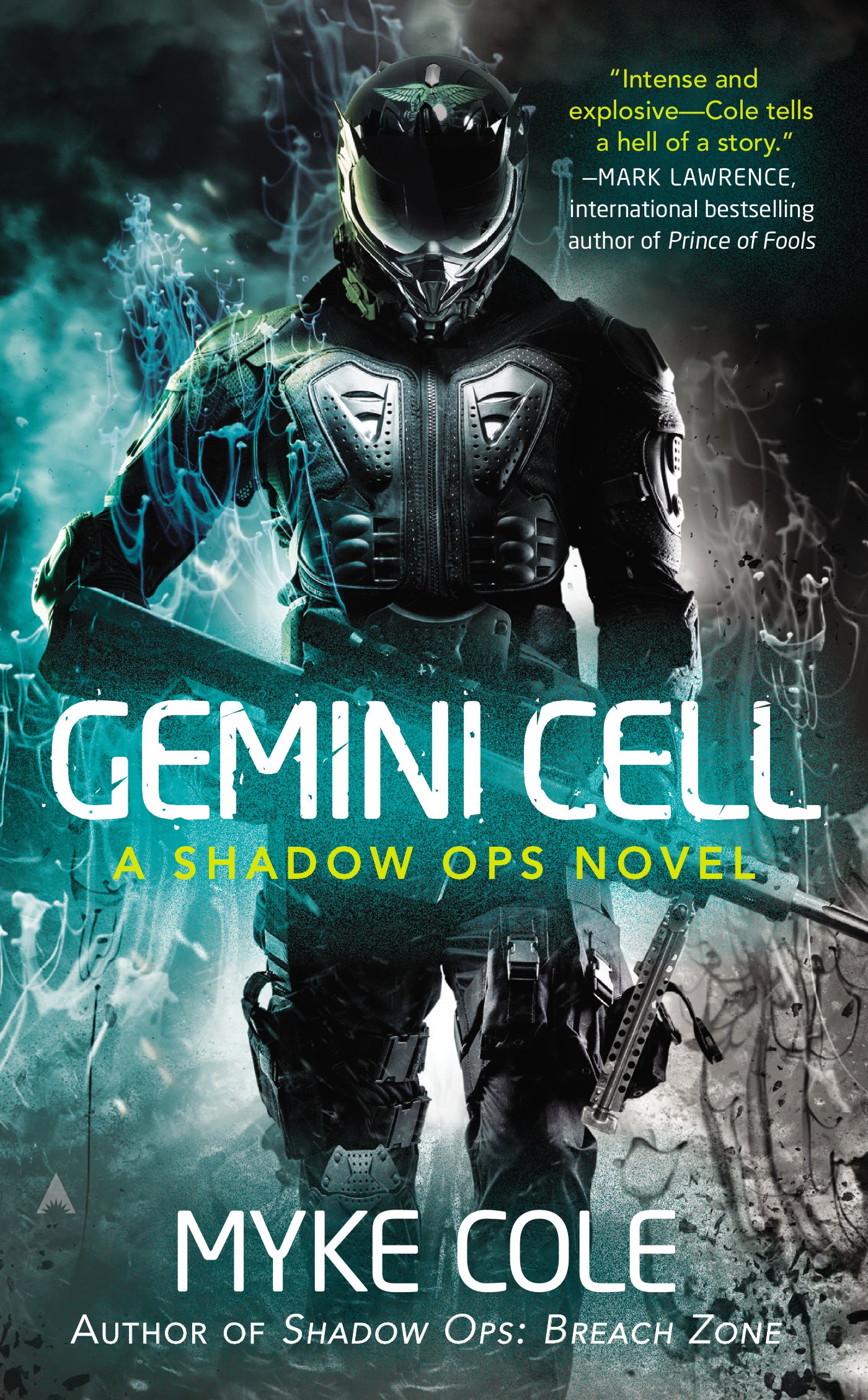
Myke Cole's military fantasy novel Javelin Rain follows Gemini Cell, and continues its tale of the dead-but-not-gone Navy SEAL Jim Schweitzer, a product of America's secret government program that uses contractors to animate super-operatives.  Schweitzer's story takes place prior to Control Point, which opened the Shadow Ops series Cole concluded in Breach Zone.  Readers of Gemini Cell will want to read Javelin Rain: it zooms out on Schweitzer's escape from his government masters and its aftermath, shows readers the off-screen bogeymen pulling the strings in Gemini Cell, and details the next segment of Schweitzer's doomed quest to fulfill his roles as a husband and father following his untimely death.

Background

In Cole's prior Shadow Ops novels, each volume followed a different protagonist, so prior knowledge wasn't terribly important to seeing the world through the protagonist's eyes: the protagonist's individual outlook was built from the ground up in each book.  Javelin Rain is different: it continues Gemini Cell's story of Jim Schweitzer, and opens promptly following that volume's final scene on the predicament readers understood would naturally follow the Gemini Cell's conclusion.  Prior knowledge of the protagonist's predicament, and the background of the actors, is important to understanding the characters and relationships and sacrifices Cole's new work presents.  That background will help give perspective to the choices characters make – especially non-POV characters developed primarily through prior action in Gemini Cell. Gemini Cell is well worth reading even if you aren't holding a copy of Javelin Rain – but if you're looking at Javelin Rain, consider picking up Gemini Cell first.

By the time of Control Point, magic powers manifest by U.S. citizens are subject to government regulation – and public service campaigns admonishing individuals with powers to register.  However, the action in Gemini Cell and Javelin Rain occurs at a time the U.S. hasn't got such regulation.  Gemini Cell and Javelin Rain take place in a U.S. whose public is not yet unaware magic has begun to manifest.  But elements of the government know, and are willing to kill to keep the secret.  By the end of Gemini Cell, the protagonist's family learns what's become of him – and are thereby marked for death.  Schweitzer, a SEAL in life and well-educated in government application of force, is unwilling to stand by while those he loves are murdered.

Open Javelin Rain.

Complexity

As in Gemini Cell, the story's major players are complex humans rather than paper-cut-out actors in a budget Western shoot-em-up.  Schweitzer's antagonists are depicted not as a unified front of faceless villains (e.g., storm troopers from Star Wars) but as an internally diverse group of individuals with motives and values that place them in conflict as much with their fellows as with their nominal enemy, and who have the power to decide for themselves not to perform heinous acts on command (e.g., storm troopers from The Force Awakens).  Individuals' capacity to learn and make decisions and change course – a major factor in humanizing the actors in Gemini Cell – remains on show in Javelin Rain.  Readers familiar with the Shadow Ops world in the time of Control Point will understand how different the government's relationship with the arcane is from that on display in Gemini Cell – and Myke Cole shows through Schweitzer's story why prior regulatory relationships were discarded in favor of the schemes that won out by the time of the first Shadow Ops series.

Evolution

It's tempting to view the prequel trilogy – Schweitzer's story – as another step in the transition of powered individuals from nonpersons to full citizens.  In Gemini Cell and Javelin Rain, agencies treat supers as government property, classified assets that cannot be disclosed upon pain of death, never allowed to retire while they can be made to function.  By contrast, Control Point opens on a world in which supers are publicly known but whose rights are curtailed by government regulations that include mandatory registration and compulsory military service.  By the end of Breach Zone, supers   achieve some support for supers' rights and stand ready to participate in the formation of regulations to protect the public from uncontrolled powers (just like citizens theoretically can participate now in how we want government to regulate dangerously uncontrolled citizens).  Between the two stories, somethins must happen to expose supers to the world. Will that be Schweitzer? Some successor to the Gemini Cell organization?  Cole has another volume to show how the government registration program is instituted and set up the events in Control point.  Even knowing where the world goes, one can't help wondering about the fate of the individuals caught up in the action:  Control Point doesn't spoil Javelin Rain at all.

The conflict in Gemini Cell between Schweitzer and the djinn that re-animated his corpse is replaced in Javelin Rain by the conflict between Schweitzer's need to employ his professional, calculated, mission-directed outlook to resolve problems, and his distraction by his emotional responses to the successive hazards directed into the path of those he loves.  The conflict between Schweitzer and the government not only continues, but broadens: his old unit makes new enemies even as it risks more personnel hunting Schweitzer and expanding its secret program to build and improve its undead strike force.  Fans of military fantasy will enjoy the technical details: how mortal soldiers arm for battle to confront an undead killing machine, how technology impacts Schweitzer's supernatural efforts, and how enemies and allies alike track a zombie on the run from the government.  If you enjoy watching high-tech equipment and magic collide you'll love the fights – fun and fast – and the escalating stakes that include immediate and mounting consequences that follow the protagonist.

And about those consequences.  In Gemini Cell we learned the animated dead could perform some limited battle shapeshifting to add bone spikes to their bodies at will. It wasn't hard to imagine that such shapeshifting might, with practice, be employed to repair damage that in Gemini Cell was depicted as a one-way street because zombies didn't heal (at least while entirely governed by hungry djinn bent on killing).  But, no.  Schweitzer doesn't learn to use the spike-extending power to regenerate or re-grow a damaged body.  Every time he slips up and allows himself to be injured, he becomes less capable and more helpless before an enemy that is only getting better and better at fighting him, and never runs out of fresh uninjured bodies to move into position for the next attack.  It just gets grimmer and grimmer.

Schweitzer's internal evolution in Javelin Rain differs from that in Gemini Cell; he doesn't go from living to dead, he doesn't gamble his immortal soul on a bid to take control of his body to save his family, he doesn't lose his self-defining career.  However, he does move from a loner fighting to discover the truth to a teammate cooperating to accomplish something too big for him to do alone.  The decisions Schweitzer made in Gemini Cell – not to allow the government to use him as an indiscriminate killing machine, to seek out and protect his family – carry him forward from the first pages of Javelin Rain.  He learns about non-soldier allies making sacrifices for him and the risks others will accept to further a mission bigger than himself.  Javelin Rain presents Schweitzer a chaotic conflict, and he's not in charge.  Even as his unhealing body is ground down in capability, Schweitzer is forced to adapt to a world that's growing darker and more dangerous.

It's a story of sacrifice and suffering that looks pretty grim as it progresses.  Schweitzer will have to change the quality of his confrontations at some point if he's to get ahead – and we don't see exactly how that will happen.  It's a good reason to see the next installment of the story, which presumably will be released next year.  It's a fun story, full of excitement and action and a decent handful of characters to worry about.  Cole uses close-third-person point of view to show readers not only his main protagonist in action, but the actions of major players still in action from Gemini Cell – and their own opponents.  We get a much better idea what's behind Gemini Cell, and a clearer idea who the enemy is.  Well, enemies;  readers can have their choice prioritizing who's most to worry about as the tale advances.

Process

As described in the Gemini Cell review and in an interview with Myke Cole, Cole's work is not a seat-of-the-pants lark but a work that results from deliberate and process-driven craftsmanship.  Readers can rest assured that the Schweitzer story has a known destination, and won't be derailed by some midway misstep that paints the author into a corner, and causes an improvised, unsatisfying tack-on ending.  Myke Cole is laying out all the elements he requires to get the story where it needs to go.  Readers leery of series must rejoice to see authors like Cole and Butcher who know where they're going and methodically drive the boat where it needs to go.

Conclusion

Javelin Rain is a must-read for anyone who's seen Gemini Cell and wants to know how an undead super-soldier is going to make good on his mission to protect his family when the government paints a target on their heads.  Javelin Rain exposes some of the machinery that Myke Cole left hidden behind the wizard's curtain in Gemini Cell, and it reveals the kinds of schisms within the government that allowed the events in Gemini Cell – and what levers may be pulled to effect change.  Worldbuilding questions raised by Gemini Cell are answered as the second phase of Schweitzer's escape unfolds – and he sets up his counterattack.  Like The Empire Strikes Back, this installment isn't intended to offer a feeling that the series has closed, but to reveal key backstory while showing the characters' limitations that will require they change their strategy before they can finally prevail (in the next volume).  At least, we can hope they prevail.  Half the fun is imagining what that will look like: you've seen stories that get grim before they get better, but Javelin Rain gets pretty doggone grim.

If you like a Tom Clancy/Zombie mashup, this book is for you.  If you like craft-driven storytelling that's going someplace, pick up a copy.  If you want to know what the government is REALLY doing with your tax dollars, Javelin Rain is the documentary you've been waiting for.

While you're waiting for your copy of Myke Cole's latest work to arrive, consider reading what the FBI is doing about the paranormal threat in the Emma Bull production Shadow Unit, which you should read in this order.  (Nowhere else will you see Steven Brust write about a hero in the FBI, as he does in the series finale "Something's Gotta Eat T-Rexes.")

Wednesday, January 7, 2015

Myke Cole Hits Target with Gemini Cell

Set in the universe of his first Shadow Ops trilogy, Myke Cole's new novel Gemini Cell requires no background from prior books to enjoy. This was also true of his first trilogy's capstone volume, Shadow Ops: Breach Zone (reviewed here);  Cole has a gift for writing books that you can enjoy without additional background. That having been said, you should go enjoy them, especially if you're reading this while Gemini Cell is still a few weeks from release.

Overview
Gemini Cell is set in an alternate universe in which modern-day military technology and tactics meet paranormal superpowers poorly understood by the government (or by initially-oblivious citizens).  Unlike the first Shadow Ops trilogy – in which government regulations spelled out how individuals who manifested powers should register and be dealt with – Gemini Cell is set in the early days of the paranormal awakening that sweeps the globe, before the rules are clear, and before the protagonist has any idea what he's in for once he find himself "in business" with supernatural practitioners.

The fact that nobody seems to understand the rules governing the supernatural powers on display in the book means that the protagonist has little ability to tell when he's receiving accurate information about the limits and consequences of his paranormal predicament, when he's being fed a line of bull, or when he's looking at fools who have no idea what they're talking about.  This raises one of the major themes of the book: information quality.  The protagonist's work in a security-conscious military organization means that he's used to activity that is strongly intelligence-driven.  Once we begin to understand that all the information he has is doubtful – or  subject to limitations that impair its utility – we see that for all his personal power the protagonist is blind, unable to achieve his goals, because he needs credible intelligence on which to act.

Another theme is reason over passion.  Professional calm is presented as the only way to obtain useful results from violence; an antagonist demands impassioned indulgence of bloodthirsty urges as the price of physical power, creating an ongoing conflict.  Myke Cole illustrates the futility of seeking balance in a series of conflicts engineered to demonstrate that without care and control, violence has no utility at all to a civilized person.

More themes appear, but why spoil the story?

By planting numerous themes early and carrying them throughout the work, Myke Cole ensures the reader understand the problems they pose when they entangle the protagonist and complicate his conflicts. The result is conflict with more than the merely-physical dimension, and resolutions readers can care about.  This is a book well done.

Protagonist and Adversity
Gemini Cell is the story of Jim Schweitzer, a Navy SEAL who doesn't expect to star in a mashup between Revenge of the Ninja and Frankenstein mixed with a dose of Ghost.  From the back-cover copy, we know Schweitzer is going to bite it – and soon.  So we are kind of at the edge of our seats from the outset, expecting him to die at any moment, but hoping he'll manage to come out okay despite everything.

The story opens in an art gallery where Schweitzer wants to support his wife Sarah as she advances a few big steps in her dream career as a visual artist.  He knows Sarah expects him to flake out over work, and he assures her he's good for the night.  He really wants it to be true, too.  You know how this scene ends already, don't you?  It helps define Schweitzer, to ground him in a world that's larger than his job, and to establish both his values and the priorities with which he grapples.

Jim Schweitzer's plot arc in Gemini Cell may be complicated by his unexpected career as an unkillable (being already dead) special forces operator, but it's largely his confrontation of the first-scene conflict writ large: he wants to do right by his family – but since his death, his job's demands have only grown worse.  His desire to make good on his role as a father and husband is so obviously doomed (the "why" risks spoilers), but you can't help rooting for him – just as you hoped he'd manage to cheat the death promised on the back cover, even if just for another page or two.

Of course, questions overhang – how, exactly, did Jim get into this mess in the first place?  There's more to learn, and you can expect future volumes to satisfy hunger for answers.

Other Characters
The story isn't all Jim Schweitzer, or testosterone-drenched white men gunning down whole armies by one-handing belt-fed machine guns whose ammo chains never shorten.  Scenes cut between plotlines about Jim, and about people wondering what has become of Jim.  The supporting cast includes people who seem by the close of the book to be mostly good, and some whom we might be persuaded have become treacherous bad backstabbers fueled secretly by cackling villainy in an IV bag.  And they're not all male: Sarah proves to be a badass in her own right, and Jim's immediately-senior NCO is a Chief Petty Officer who boards target vessels with her team and shoots as effectively as she commands.  Techs in the unit Jim lands in after his re-animation are a co-ed lot, and guards appear in both genders.  Names and physical descriptions paint a full-color world with multiple nationalities and racial backgrounds.  Jim's best friend is Asian.

The supporting cast isn't just a cheering section or a mook squad.  Repeatedly Jim finds himself in positions in which his ability to act effectively turns on support from others.  It's not an ensemble cast, of course;  the story really is about Jim Schweitzer.  But it's not Conan – and in the twenty-first century, that's a good thing.

Darkness
As in prior Myke Cole books, Gemini Cell includes a lot of conflict that starts close to the heart.  Tension isn't presented purely by targets:  characters suffer internal conflicts, trouble with work, concern about information that's withheld from further up the chain of command, known and unknown betrayals by people in positions of trust or authority, and more.  Jim depends on his unit to support him following his re-animation, but can he trust what its spokespeople tell him?  The whole scale of revealed and suggested conflicts risks spoilers, but the fact the good guys live in a world of iffy intelligence and dubious loyalty makes the place a lot darker than military thrillers that focus more on the gung-ho aspect of unfolding neat military plans on an unprepared opponent, or manly men outnumbered and surrounded but fighting their way to victory with their backs to wall.

There are unprepared targets in Gemini Cell, of course … but are they all bad guys?  How would the good guys ever learn?  The book hits a few times on the ambiguous position of good guys who act (with finality) on information they know is incomplete.  They trust the information, and the instruction to shoot, even without the means to tell independently what treatment best suits each target.  This invites interesting questions.  What if the wrong people ended up in charge of the unit?  (Either one, really: the one he started in, or the one into which he was re-animated….)

Are the wrong people in charge already?

Well.  We'll see.  I hear the next one's called Javelin Rain.

Craftsmanship
On social media and in interviews, Myke Cole has revealed that he is not a seat-of-the-pants writer, but meticulously plans his stories and subjects his manuscripts to a grueling edit process that yields multiple successive drafts.  From his comments, it's clear the process is painful.  But from this end of the product pipeline, I can say this: it's worth it.

Cole knows where his protagonist must go and what mysteries he must unravel, so with careful planning he is able in this volume to set up and solve a one-book problem while laying the groundwork for the protagonist to advance into bigger problems that require the first volume's knowledge to solve.  There's no question that Cole's grueling production process yields a better-designed, better-paced work of fiction than one can expect to get from a less rigorous process.  For an example of another author who relies on a demanding planning process to engineer reliably outstanding stories, book after book, without painting himself into a corner or writing duds, consider Jim Butcher, author of the 6-volume fantasy series Codex Alera and the still-in-progress-after-fifteen-volumes Dresden Files series.  Jim Butcher's praises have been sung here since 2008.  It's about the craft.  Butcher's success proves rigorous process works, even after dozens of books, and Cole's universe is a wonderful place to see the result of this technique on display.  It's hard work, but Cole understands it's necessary.  And he's out there right now, hard at work on the next volume, suffering for your amusement.

Readers: you're in good hands with Myke Cole.

Conclusion
Cole's universe is populated by characters with interesting internal and external conflicts that are easy to get interested in seeing resolved.  People who worry about picking up a series' first book out of cliffhanger-dissatisfaction concerns need not worry.  Gemini Cell closes the story arc on which it opens, and it feels done when it closes.  Sure, the characters identify some doorways for later books to breach, but rather than detract from the work this builds anticipation for the character’s development.  The climax puts Jim to the question he's needed to answer from the first chapter, and sets him on the path to solve the problems he's unearthed on the way.  It’s a good day.

And it's fun.  After the initial anticipation to see the back-cover discussion of Jim's death play out – turns out, he’s tough to kill – readers enjoy a long sequence in which the action and suspense in the two main plot threads make the book hard to put it down until the end stands in sight.  Unless you enjoy losing sleep, pick it up early in the day.  You've been warned.

Myke Cole’s Gemini Cell offers an exciting story about a new character with a novel superpower-problem, set in a universe he's had three other books to understand fully enough to embed a mystery that will take another couple of books to solve.  I look forward to those books – and so will you.

(For those interested in an interview with Myke Cole, try this one, on which the author says, "I love new and unusual questions."  Also, his mother read it and said, "What a great interview!"  So read it, already.)

Thursday, December 25, 2014

Gotham: A Review

I recently read Devin Faraci's pan of the TV series Gotham, and felt obliged to respond.

Gotham is for people interested in what Batman's world looks like without the Caped Crusader to rescue anyone.  Without Batman, the city retains all its grit, corruption, deceit, danger, and weirdness – just no Batman to save the day.  This makes it much more like a gritty crime story, except that the weirdness of a superhero's city is added – without offering a built-in rescuer to save the city and its inhabitants.  Gotham is Batman for the self-help crowd, as it were.  But it's a it more: because it's set in Batman's Gotham before Batman comes into his own, it offers a view of Gotham from an angle we've never seen.  Gotham's pre-Batman history isn't delivered in flashback to inform some years-later adventure, but in its own story: how Gotham created Batman and the villains he opposes.


This isn't just back-story for Batman fans, though. Batman fans will enjoy watching Bruce Wayne's eventual foes develop into the supervillains only Batman can battle – some, as they ascend in the criminal ranks … and some, as they work alongside the protagonists as apparent allies, not yet having turned to the dark side, or perhaps not yet getting caught.  But the villains' ascent and Gordon's fight against Gotham's corruption offer story enough without needing to see how young Bruce Wayne becomes Batman (a story we've seen depicted enough not to be exactly on the edge of our seats about).

The writing is patient: it shows us characters we know become major parts of the Batman canon, building anticipation for their development into the personas into which we know they will evolve.  It doesn't rush this.  At the same time, though, the writers understand viewers want to see stories end with episodes: we get fully-formed stories involving characters with which the audience is unfamiliar, which allows surprises. And it does more: it allows us to look at the characters while they are still malleable, still fully human, and before they have become roles in a comic book.  The show's chief, Bruno Heller, understands exactly why these characters are more interesting before they don their capes and masks:
Frankly, all those superhero stories I’ve seen, I always love them until they get into the costume. And then it’s, “Oh, okay, they’ve ascended, they’ve stopped becoming humans.” It’s their apotheosis. They go to heaven and they’re Superman. There have been so many great versions of it. This is a version of something else entirely.
Bruno Heller, interviewed by Entertainment Weekly
And the acting is outstanding.  Just.  Outstanding.

Although the show is built around the police work of James Gordon, it's hard not to start with Gotham's rising villains.  Jada Pinkett Smith's Fish Mooney is such a gloriously ambitious crime boss, just waiting to take the crime-lord crown from the old guard gangster running Gotham, that you can't help cheering for her bloody advance.  She's that good.

Robin Lord Taylor's Oswald Cobblepot begins his ascent-to-supervillany character arc in the very first episode, in which he acts as Fish Mooney's umbrella-holding toady and must suffer jeers and sleights with stoic endurance as, for example, his post-leg-injury gait earns him the undesired nickname "Penguin".  He's so obviously not a supervillain – yet – that it's hard not to ask how this pipsqueak becomes a feared Gotham crime lord.  It's delightful to see just how awful the timid-looking toady proves to be once set in motion, how he develops in strength as he manipulates and threatens and kills … hard not to watch.  It's a much faster development than we see from the child Bruce Wayne, which offers us patience for the longer plot arcs.  And Taylor's so compelling in the role you can't help cheering his Cobblepot against his criminal competitors.

When is Cory Michael Smith's Edward Nygma going to snap?  We keep seeing him as a crime scene tech.  But one day – one day ….  Selena Kyle, portrayed by Camren Bicondova, isn't a villain yet, just a street-smart survivalist with sticky fingers.  (And a host of survival skills to teach young master Bruce!)  There's plenty of mid-level thugs, including one played by David Zayas (as "Don" Sal Marone), but they become burdensomly numerous. Behind them all stand John Doman's crime boss "Don" Carmine Falcone – maybe the most vanilla villain on the show, but plenty scary for all that.

But the show is built around James Gordon, long before he becomes Commissioner.  Benjamin McKenzie portrays James Gordon as a newly-minted Detective in a crime-ridden city that suffers corruption so deep it eventually surprises even jaded TV viewers familiar with the Batman universe.  Gordon's effort to retain his life without losing his soul is the heart of the show, and it's wonderful to see.  Occasionally grounding him with his as-yet unfulfilled promise to find the boy's parents' murderer is David Mazouz' Bruce Wayne – who's done an outstanding job – who in turn is being raised by his badass butler and guardian Alfred Pennyworth (absolutely beautifully done by Sean Pertwee), who has some firm ideas how a boy should be raised.  Heh, heh.

Gordon's older, jaded partner Harvey Bullock (masterfully portrayed by Donal Logue) is a piece of work from the start: friend or foe? Both?  Gotta love Gotham.

But, the bit players are important, too.  People who've never appeared in the Batman canon – blank-slate characters whose fates a viewer can't know in advance – make the episodes possible.  It's these whom Heller uses to shape the personalities of the canon characters, and they offer us delight after delight as we see characters we know learn for the first time lessons that later define them.

Cinematically, it's gorgeous.  Filmed in HD, the grim and gritty Gotham is as full of people as it is of litter.  The streets, the buildings – it's got the beauty of a feature film without the distant-as-Olympus feel of some of the sets shot in the Batman movies.  It feels like a city you could see destroyed by greed and corruption while you watch.  Backed by the superb acting of a huge cast – crime bosses and their lieutenants, rank after rank of police, crime witnesses and victims, administrators and prosecutors, nascent supervillains, crooked politicians – there's little so big on TV.

I'm dying to go to the defense of the Balloon Man episode that drove Faraci from the show (it taught Bruce the hunt for justice can't itself be murder, a lesson we know survives into Batman), but it contained all kinds of graphic-novel-ish goodness and irony.  For one, the scheme: corrupt government employees are handcuffed to a weather balloon and launched to a fatal altitude … until their corpses plummet back to Gotham.  What's better than this for a vigilante murder scheme?  Imagine the fear as the cuffs click, once officials know what's coming.  But, it's murder – and Gordon is sworn to bring murderers to justice.  The fact he sympathizes with the killer's frustrations with Gotham's broken government is a bitter pill to swallow.  And then there's Bullock's preference to let the Balloon Man soar into the stratosphere himself.  Critics have attacked the fact that a dark show like Gotham uses something as whimsical and comic as a balloon for a villain's calling card.  This is exactly backward, for two reasons.  The Balloon Man isn't a villain at all, he's an anti-hero being busted for the felonies he commits in his misguided attempt to set Gotham straight.  He is, in fact, exactly what Batman must not become.  The whimsical balloon motif is perfect for Gotham: it's a nod to the culture that must exist to produce the weird future full of costumed villains with which the city is doomed to be inundated.  The bizarro scheme is exactly what Gotham needs; the anti-hero collar is exactly what Gordon needs to taste, sour in his mouth, to prepare him for a future in which Batman running free feels a reasonable compromise;  and all the little conflicts with other characters are perfectly balanced to nudge everyone where they need to go.  Oh, and the epidode's story problem is solved while moving everybody a little forward in his or her appropriate character arc.  It's a solid work, fun, awful, and in every other way a delight.

Fans of Batman can hardly find a better show.

Sunday, August 24, 2014

Ready Player One, Reviewed: Yummy '80s Nostalgia Feel-Good

Ernest Cline's Ready Player One is a feel-good rags-to-riches '80s-nostalgia quest set in a dystopic future and the immersive alternate reality in which its residents transact most of their online existence.  The story is a sort of Brewster's Millions meets Charlie and the Chocolate Factory.  Unlike the protagonist of Brewster's Millions, the narrator isn't predestined to get a crack at inheriting – he's in a race against everyone else looking for the dead man's loot.  As in Brewster's Millions, he's beset by cheats looking to sabotage his quest in their own self-interest.  Worse, the route to victory is much less clear than in Brewster's Millions – in that book, it's at least evident how one should behave to accomplish the mission (also, Brewster's Millions has  only one contestant).  Ready Player One presents a multiple-stage quest driven by riddles that depend on knowledge only dyed-in-the-wool geeks steeped in '80s lore could possibly unravel.  The payoff? In the tradition of Roald Dahl's Charlie and the Chocolate Factory, the prize is fantasy-land itself, and the right to run it.  The end echoes Brewster's Millions: the hunt for the "Easter Egg" hidden in the VR universe forces the narrator to immerse himself in a pretend world that ultimately teaches him he must live in the real one.  It's an uplifting story made all the more hopeful by the miserable dystopia in which it's set.  Loved it.


Sympathy for the downtrodden protagonist is built quickly enough that the occasional, hefty block of multi-paragraph infodump worldbuilding is easy to accept in what feels an earned confidence the story is worth the effort.  The sense of infodump was greater on re-read than on first pass; much is also historical trivia that can be fun to experience in the context of the '80s-nostalgiafest that is the in-game contest.  And some is really unavoidable: historical computer game details and how to exploit their bugs turns out to matter, and the reader can't be assumed to know the huge variety of '80s trivia the protagonist has amassed in order to master the in-game quest.  Several scenes clearly show the author intended a specific image appear in a film adaptation, but this break from storytelling to film direction doesn't come often enough distract one too badly from the story.  And maybe they won't distract you enough to push your head from the story as they did me.  Maybe you'll like them.

The book is a fun read.  Loaded with pop cultural references, it's hard not to giggle eventually even at such things as the names of VR planets.  Anyone who grew up with computers from the era of text-based games will adore the competitions laid out before the characters.  I can't say what people will think about the story that haven't lived through the '80s, but the book's nonstop celebration of fandom will appeal broadly to those for whom music, movies, or games ever formed an important facet of life.    A strong female character is revealed early on – and not simply to rescue.  Although some late-appearing pro-gay and pro-minority elements have a bolted-on feel, the gender equality is baked-in and can be tasted throughout.

Part of the story's triumphant feel comes from its Cyberpunk sensibility, depicting individuals awash in a sea of overwhelming social and corporate powers that seek to crush them into industrial lubricant – the perfect place to showcase human triumph at the individual level.  And that's part of the book's charm: it doesn't depict Conan (or even Molly Millions) wiping the floor with corporate goons, it shows individuals working for a common cause – as individuals – to triumph personally over the dehumanizing social machine.  In an interview on urban fantasy, author Jim Butcher pointed out that Mark Twain advocated a formula: for every plausible-feeling fiction the author must mix two parts truth.  Ernest Cline provides, first of all, a plausible environment – who doesn't believe people flee their real-world lives for an online experience even now? – then populates it with plausible villains.  The corporation seeking control of the OASIS online system evidences motives and intentions readers will find extremely plausible in the current age of targeted advertising and e-snooping.  The fact that it also turns out to be a credit card company that collects debts using indentured servitude none are expected to repay simply mines history for mining towns, company stores, debtors' prisons, indenturement, and a host of other real-world evils that aren't hard to imagine returning to vogue as individual rights continue to erode.  Half the setting's feel comes from the fact there's no effective government to keep wrongdoers in line – precisely why the online OASIS is crucial to preserve: it's a place a benevolent omnipotent caretaker is not only possible but has become (at least in the fictional world) necessary.  The dark world is close enough to the one people know – or at least, the one they fear coming – that it's an easy sell as a future setting.  The plausible dark future and its plausible greedy villains are a perfect place to put good-hearted people in jeopardy in order to prove their mettle.

And save the Universe.

If you spent much of your formative years in the '80s, you must read Ernest Cline's Ready Player One.

Saturday, July 5, 2014

Cuinn's "Different League": Short Noir Fun

Carrie Cuinn's publications list includes several available online for free, including "A Different League", part of Akashic Books' 750-word-limit Noir series Mondays Are Murder.  I enjoy discovering authors I don't know, and I love the mood that makes noir noir, making this review a real pleasure.

Perhaps the most enjoyable part of the story is the range of lies the private eye and her client tell each other. Sure, the narrator isn't expected to disclose her financial desperation or her inability to afford what the client wears, so we let that slide without remark. But the end twist reveals how much more of the characters' interaction has been a deception – as it turns out, long before the curtain opened. And the reveal is fun. Cuinn's calculates how to dispense information, reverses the reader's calculation of the characters' motivations and stakes, and lands everybody in a much better place than they started.  How often do you find a noir with a happy ending?

I haven't read Cuinn's other work, but now I'm intrigued.

Saturday, March 29, 2014

Go Read The Goblin Emperor

http://www.amazon.com/gp/product/076532699X/ref=as_li_qf_sp_asin_tl?ie=UTF8&camp=1789&creative=9325&creativeASIN=076532699X&linkCode=as2&tag=thejadcon-20Katherine Addison's The Goblin Emperor is a coming-of-age story set in an Elfland empire during a time of airships and mechanical clocks. The titular Emperor – an outcast youngest son – finds himself not only unprepared for a position none thought he would inherit, but beset on all sides by opposition fueled by class, race, sexism, ambition, misinformation, ignorance, greed, tradition, and every other force acting on the empire and those who shape its future. The story's scope slowly broadens from one boy's bewilderment to an enormous intrigue involving the Empire's relations with foreign nations, the internecine competition within the Empire, political disputes over infrastructure development, and a host of prejudices.

Why You Want To Read The Goblin Emperor

The Goblin Emperor depicts an empire entangled in a complex web of internal politics, personal pride, public corruption, conflicting philosophy, international tensions, technological innovations, family ties, social customs, class division, economic competition, educational divides, and imperial traditions. The author weaves ignorance, greed, and hatred into a rich tapestry; opponents can't simply be murdered off or dismissed because many of them are perfectly good people in need of a few true facts.  The protagonist must choose whether to surrender or fight every time he's confronted, and the reader learns who he is by the battles he picks.  Along the way, he teaches himself and those about him who he is.  (At least, those who bother to look.)

Told in close-third, The Goblin Emperor follows Maia's ascent – from an ignorant boy under the fist of an exiled drunken bully, to a minority-race Emperor surrounded by courtiers who would happily see him sink into a soft life as prisoner in an imperial residence.  By actively involving himself to ensure the competent investigation of last emperor's death in an airship wreck, Maia makes himself  the target of those whose last assassination brought him to the throne.  Maia isn't drawn into defending all his dead father's policies, but he's brought to discover just what a complex world he's joined.

The prejudices that drive so much of the conflict in The Goblin Emperor aren't trite character tags, but plausible-seeming convictions as variable as the characters are diverse. As characters learn more from each other, the reader learns which quickly abandon false ideas, and which cling to their views despite the facts like the small-souled bigots the author clearly intends them to be.  Maia distinguishes himself not because he's got a magic wand (he's useless at magic) or because he was born to fulfill some great prophesy (he was born to die in exile). He also doesn't distinguish himself as a warrior (he gets the worst of every physical confrontation).  His distinguishing characteristic is that he possesses and maintains his humanity.  The coming of age story culminates not with a coronation or a marriage but with a decision to do something big for the people he rules despite the headwinds he faces getting it off the ground: he makes good on something that matters to strangers.

Traditional Jaded Consumer Content Alert

The Jaded Consumer generally includes a note or two on aspects of a reviewed work for readers whose peculiar sensitivities may be upset by some otherwise innocuous aspect of a fictional work.  For example, some readers may be sensitive to the appearance of genuine belief in real-world religions, such as appears in Eliza Crewe's Cracked.  In Steven Brust's and Skyler White's The Incrementalists, the Jaded Consumer noted a reader would find politicsMyke Cole's Shadow Ops series offers optimism about the human condition.  Naturally, none of these are fatal. A reader with the certain senstitivities may be, shall we say, mismatched to a book.  Content alerts are for these less-than-fully-omnivorous readers.  If you're made of tougher stuff, feel free to skip this part. The content alerts here are based on speed and politics.

Until the protagonist – Maia – becomes embroiled in the Empire's complexities, the reader sees nothing but his personal worries and fears.  The reader learns about the world no faster than the main character.  If you enjoy only action sequences, and lack patience to watch characters discover their world and themselves, this book is not for you.  This isn't a story about a conquering hero or a successful warlord.  The protagonist inherits his title when everyone ahead of him in succession unexpectedly dies.  The meat of the story is about what Maia does after inheriting – the choices he makes while dealing with people and exercising power.  This isn't to say Maia does nothing; his decisions have a enormous effect on the allies he makes and the success of his reign.  Without these decisions, he'd never keep his throne.  There's conflict, and there's decision, and there's change.  But if you require a heavy diet of fight scenes and chases, this is not the nail-biting thriller you were looking for.

Readers used to a breakneck pace may find this story's pace more stately than they are accustomed. The pace has definite causes.  Sentences are not whittled to their barest parts.  Facts are not bare; even pronouns are occasionally given long discussion. The non-English language of the Elves apparently has a formal first person (depicted as "we"; it's not the royal "we" because characters other than the Emperor employ it), a normal first person, and second-person pronouns that vary with familiarity.  Speakers of European languages may find this circumstance more familiar than English-only speakers, but the author spends time describing the effect of these pronouns' use in dialog between characters whose relationships are changing. This isn't surplussage or waste, but it's a level of detail that has an effect on the speed with which anything can be described: things can take a while. This doesn't mean they're boring to persons of normal sensitivity, but the fact may be of interest to readers who know they demand things move at top speed. 

Then, there's politics. [SPOILER] The Goblin Emperor drops lots of details on the reader to illustrate the brokenness of the empire Maia inherits.  Inequity in educational opportunity, gender rights, and all kinds of areas are all dropped on the reader as on the new emperor, and we sense the emperor intends working on all these things.  The protagonist articulates no promise or plan for them all, but the reader is given a clear idea that there's much work to be done in the empire, and plenty of evil to be had in unconcerned government.  The Goblin Emperor advocates social reform by condemning gender roles, bullies, and the apparatus of established power.  To the extent the reader wants Maia to succeed, it's because the political necessities suggested by the author resonate with the reader: we want the empire's victims saved from the laws and customs that drive artisans blind weaving fine silks, ruin women's educational opportunities over socially-assigned roles determined by gender, and oppress the working classes to the point the emperor is unable to fault a villain's conclusion that all the good accomplished by the protagonist has been made possible by an establishment-toppling multiple-murder just before the opening curtain of Chapter One.  [/SPOILER]  The Goblin Emperor is, therefore, political: it not only urges that genuine humans are needed in power (implying that the kinds of oppression depicted in the book prove their perpetrators are less than fully human), but it comments on the role of violence in these reforms in ways that could easily upset persons of tender sensitivities.

I certainly enjoyed The Goblin Emperor, but those readers with peculiar sensitivity to pace or politics should be aware how each work in this book.

Details. Glorious Details.

The author spends considerable time showing the reader details.  For example, the outrageous ostentation of the top tier of society in the Empire is depicted in recurring descriptions of dress and adornment and the conduct of servants.  The author's recurring discussion of personal pronouns signals a willingness to examine minute details in the interest of painting The Goblin Emperor in full color for the reader. Despite clear willingness to slow to provide detail to readers, The Goblin Emperor did surprise with non-detail in two places.  Near the beginning of the book, Maia looks from an airship at a "beautiful" view of the sun on the horizon.  Later, he looks on a "surprising" gift clock. The build-up to each event engendered an expectation of some description why the adjectives were warranted. What sort of beauty? What kind of surprise? Colors? Shapes? Movement?  These things weren't important to the story, but the detail painted for the hair accoutrements and carriage attendants and jewelry and so many other non-critical things led me to blink in surprise that these descriptions were omitted.  But these details don't affect the story, so what does it matter?  Katherine Addison showers readers with beautiful details that depict the alien worlds of the Elves and their Goblin neighbors.

Readers who want to get all the information encoded by the author in her writing may wish to note that the book has a useful appendix.  "Extracts from A Handbook for Travelers in the Elflands" – purportedly a Crooked Stair Press product printed for the Royal Merchants Guild of Porcharn – may be worth bookmarking by those who want to understand when the author uses a family name to describe the whole family and when the author intends using a family name to explain the gender and marital status of an individual.  The author divulges the system for decoding the endings affixed to family-name roots, and this may be of real help to people hoping to keep straight which of two related people are being described (which could be disambiguated by gender, for example).  I personally found myself hard-pressed to keep straight the large number of long and alien-looking Elf names, but at least decoding them into gender and marital status is a help.  In a paper edition, dog-ear the "Handbook" at the end.  It's not essential to enjoyment, but it's an aid one should know exists.

Conclusion

The Goblin Emperor is an exciting look at a near-orphan coming of age in a hostile environment with nothing about him but his (largely uneducated) wits.  It's an underdog story.  Sure, the "underdog" is Emperor, but he's surrounded and outnumbered and bewildered, and his only "ally" in Chapter One is the drunk who beats him.  We want poor Maia to succeed, and we're interested to see his humanity as he refuses to become the monster his accession to power invites.  We want him to succeed not only in the sense of overcoming enemies, but in the sense of overcoming the urge to descend to their level to do it.

The Goblin Emperor comments on family, government, privilege, discrimination, and all kinds of things – but it's about the triumph of humanity on the only scale humans can really feel: one on one.  Maia must teach individuals he's worth taking seriously as a human, and he must rescue others from misery, one at a time.  There's a nation to save – perhaps a whole world – and it's too big for one person to fix.  But Addison's emperor shows us the only success that matters: one individual's triumph against despair by doing better for others than one's been offered one's self.  The victory of The Goblin Emperor is survival without losing one's soul.  It's a journey that's wonderful to see in print, just as we long to see it in the waking world.

The Goblin Emperor is well worth reading, and I'll look forward to more from Katherine Addison in the future.

Thursday, March 20, 2014

A Look at 'Lovecraft's Monsters'

http://www.amazon.com/gp/product/161696121X/ref=as_li_tf_tl?ie=UTF8&camp=1789&creative=9325&creativeASIN=161696121X&linkCode=as2&tag=thejadcon-20Come tax day 2014, Tachyon Publications will offer even greater horror.  On April 15, it will to loose Lovecraft's Monsters upon the world.  The collection celebrates Lovecraft-crafted horror with short works that play in his sandbox.  H.P. Lovecraft's tales generally relate one narrator's exposure to new-discovered clues of looming supernatural threats from awful gods. This collection showcases diverse authors' depictions, from wildly different points of view, of different slices of life in a Lovecraftian community.  The result is a delightful array of little pieces that range in mood and subject.  Unholy sacrifice, forbidden love, a private dick on the trail of a murderer – there's something there for everyone.

The eighteen tales' breadth is sketched briefly through a few samples.

Niel Gaiman's short "Only the End of the World Again" offers traditional European horrors of folklore hunting the same world as Lovecraft's beasts and their awful worshippers. Werewolves may be the bane of man, but are they also the only thing between our world and the ascendance of unpronounceable tentacular horrors from the deep?

Laird Barron's "Bulldozer" follows a Pinkerton on the trail of a wanted man. Well, maybe not entirely a man. The salty feel of the hired gun is nothing like the prose of Lovecraft or the authors who cleaved to his style.  The tale gives a feel of Deadwood while it depicts how the weird world looks, approached from the outside.  Watching a normal drawn into a descent is quite a ride.  There's damned, then there's damned.

Caitlín R. Kiernan's "Love is Forbidden, We Croak and Howl" gives a glimpse of love from the wrong side of the tracks – in a town where the elite aspire to consort with demons.  It's a beautiful romantic sketch, made horrible as one imagines the aspirations of the town's youths. Ugh. But … a happy ugh.  Come, read this, and wish good things on inhuman beasts.  It's not like they don't have dreams, too.

It you're a fan of the weird, this is your book.


Review: Wheeler's Fireblood

http://www.amazon.com/gp/product/161218720X/ref=as_li_tf_tl?ie=UTF8&camp=1789&creative=9325&creativeASIN=161218720X&linkCode=as2&tag=thejadcon-20
Jeff Wheeler's novel Fireblood is the first volume of his Whispers of Mirrowen series. Like his Muirwood series, it spans three books.  Unlike the Muirwood series, its three volumes didn't share a single publication date: readers wanting the whole tale will have to wait until the third volume is published in the future.

This leads to my first gripe: like Connie Willis' time-travel story comprising Blackout and All Clear, no one volume tells a complete story.  When I read Blackout, I immediately realized that without access to its sequel I'd have been incensed to have been led into a book thinking I was getting a story, only to find it cut short with no resolution to any part of it.  I felt I'd been sold the result of one good book being fed through a buzz saw and vended in halves.  That's not to say the story isn't delightful and moving, but for safety's sake don't pick up Blackout without easy access to All Clear.  To be fair, cutting stories into bits and selling them in different volumes isn't new in fantasy. Tolkein's Lord of the Rings trilogy may have enshrined the practice from the genre's very beginning.  But it's this reviewer's fervent hope that writers will see what Jim Butcher has proved with his two separate fantasy series, each of which is comprised only of novels that tell satisfying and complete stories: people love to read reliably good stories and will buy them if you prove you can write them reliably, especially if you keep the same characters alive and evolving and interesting for fifteen volumes (and in the Dresden Files, heading past twenty).  But this is a gripe.  People read the Lord of the Rings, and they read the Oxford time travel books, and they'll keep reading volumes that don't tell complete stories so long as they feel confident the whole story will satisfy.

What's Right
Fireblood does several good things.

Unlike so many fantasy worlds, Whispers of Mirrowen decouples race from culture.  This doesn't sound like a big innovation, but the result is a much more complex social fabric in which national politics, social competition, and racial tension give a full-color feel to motives and enmities that in other worlds are simplified into elf/dwarf rivalry. Mind you, elf/dwarf rivalry worked okay for Terry Brooks in Wishsong of Shannara when readers were already committed to the story and distracted with other concerns, but the fewer things one must suspend disbelief about, the easier it is to get lost in the story. And isn't that why we're reading it anyway? (What did Brooks' elves and dwarves do to each other that we believe it?)

Whispers of Mirrowen offers interesting magic.  Many types exist, each with different costs and limitations. Since races and cultures cross boundaries of politics and faith, the powers that work for protagonists also work in equal measure against them. What readers learn about magic when it's working for protagonists hangs over the reader, creating tension as we see antagonists access the same kinds of powers.

Characters have believable conflicts, including among protagonists.  In several places one wonders whether villains will derail protagonists, or their own squabbles and fears.  Wheeler's third-person narrative shifts of focus between characters so readers can see enough of what characters secretly think and dream when they're alone to help them understand the collision of motives, but it leaves enough unexplained to raise tension when the collisions occur.

Content Alert
Jaded Consumer fiction reviews traditionally contain a variety of "content warnings" regarding various aspects of works. The warnings aren't for everyone, and need not keep people from finding work an enjoyable read. Whether it involves politics or religion or merely an optimistic outlook on the human condition, content alerts aren't intended to damn work but to alert people whose tastes run in another direction.

As intimated in the note above about the story-incomplete volumes in this series, it's the Jaded Consumer's conclusion that Jeff Wheeler read Tolkien.  Maybe … maybe the wrong way.  Here, the Jaded Consumer refers to the pace of the work. For instance, the first chapter introduces a character whose band of adventurers has been slaughtered down to a single ally and left stranded in the deepest depths of hostile territory, just as they're found by undescribed awful clawed things.  One would think his lost-ness and desperation would lead the chapter – they are what makes it interesting, and what must draw the reader if anything does.  They're the hook, right?  But, no. Fireblood opens with the weather.  This appears an intentional artistic decision – apparently for structure; the chapter closes with the weather, to which the scene outcome is attributed.  Once the real problem in the scene became evident, I wondered why it was I didn't care about the protagonists' desperate plight.  It felt buried in description to which I had no emotional connection.  The rest of the book picks up.  But as in Tolkien, sentences avoid quick subject-object-verb structure; the ideas curve lengthily about dependent clauses and description that feel like they insulate one from the story's grip.

And it's got a grip.  This is a story I'd like to see finished (see above; this is not the first story in a three-story episode arc, it's the first segment of a single story cut into three pieces).  People who require modern stories' fast pace may not want to stick with something written with the slow description of a book from another age.

Toward the end of the book, the story's grippiness takes another blow as the big mysteries behind the current conflict are revealed to the protagonists (and the reader).  It comes as description, with long dialogue giving secondhand encapsulation of facts that sound like they'd be exciting to see firsthand.  When Rowling faced the burden of heavy exposition in her Harry Potter series, she invented a fantasy gizmo that allowed him to see events firsthand – so the reader would see the action with the protagonist, instead of merely hearing about it. Fireblood's pace takes a hard blow under the weight of heavy exposition.

Culture Shock
I enjoy the multiple fantasy cultures depicted in Fireblood, but one bothered me.  Fireblood depicts a "Romani" people that appears to echo the worst stereotypes of the real-world Gypsies/Roma/Romani, down to child-stealing, human trafficking, misogyny, and an ostensibly pervasive culture of criminal enterprise.  This is a fantasy world; why do we need to trade on prejudices against a real-world ethnic minority?  It'd be easier to hate them as the author wants, if we weren't worried we were being urged against a real people nearly exterminated in some parts of the world by people preaching their difference.

Back To Our Scheduled Programming
Fireblood's sympathetic characters' intractable problems lead them not only into each other's orbit, but into inevitable conflict.  It's not trivial conflict, but feels important – not just to the characters, but their world.  If the characters weren't interesting, one wouldn't care. If the stakes weren't interesting, one wouldn't care.  Wheeler gives readers a real invitation to follow the story he weaves.

Conclusion


If you're suited to the pace, Fireblood offers a complex world full of interesting problems for characters that are easy to like.

Thursday, January 2, 2014

Once More Into The Breach

Myke Cole's newest Shadow Ops novel Breach Zone is the first of his work I've read.  For this reason, the reveiw focuses on Breach Zone as a stand-alone novel rather than viewing it as the continuation of a series (which – review spoiler – the book was good enough to inspire me to read).

Overview
Drawing from personal experience with military and law enforcement, Cole paints a nightmare in which police objectives and military objectives become intertwined with personal liberty issues that provoke insurrection in a dark alternative universe in which individuals stand at risk of spontaneously manifesting potentially uncontrollable – and in some cases, outlawed – superpowers. Since people can't pick the powers they manifest, insurrection ensues.  In the Shadow Ops universe, insurrection can be supported not only by personal superpowers but mythological races and Apache gods bent on objectives less noble than liberty and justice for all.  While Myke Cole's newest work involves characters and events a new reader can tell have appeared in previous novels, readers have no trouble picking up not only key characters' motives and back-stories, but can easily find and follow the characters' nuanced and conflicted relationships with each other, their society, their government, and those with whom they work. Another set of divides that's interesting to see explored are the ones between military and law enforcement, between military and civilian command, and between supers who conform to the laws governing supers and those who can't or don't.  New readers can follow those just fine, too. The Shadow Ops world's a complex place full of ugly contradictions.  Myke Cole paints a portrait of the characters and their environments that make it easy to understand the motives behind every scowl and slight.  It's a thing of beauty.

Billed as a military fantasy, Breach Zone doesn't read like the worshipful documentary of a military venture. The book is sympathetic to the antagonists:  the believability and sympathy of adversaries' motives, for example, makes Scylla's personal tragedy much keener than if she'd been crafted of enchanted cardboard like certain other fantasy villains Who Must Not Be Named.  It's hard not to root for her redemption.  The train-wreck laid out for the reader is an exciting tale of inevitable and avoidable but utterly wasteful destruction – tragic but hopeful – and it's a great ride. 

Out of Order Reading
To read Shadow Ops: Breach Zone before the earlier Shadow Ops books is not only possible, but enjoyable. Some of the terms used in the Shadow Ops world – a Probe isn't a measuring tool – won't make sense for a while unless you start with the Appendix (which gives a little world overview), but even world-specific definitions eventually become clear without resort to the Appendix.

Shadow Ops isn't an episodic world in which books don't affect one another; events have a chronology and the outcomes of prior books clearly affect events in Breach Zone. The biggest risk in out-of-order reading isn't confusion but spoilers: characters' backstories are intertwined with the events of prior books, and the aftermath of earlier conflicts forms the basis for current attitudes and current problems. So, reading Shadow Ops first tells you how prior books' main conflicts shook out and who lived.

But if you can read Breach Zone and can't lay your hands on Myke Cole's other works yet, don't despair: you can enjoy it just fine.

Why You Want To Read Breach Zone
Military thrillers often stand on plot to hold readers, and play on your appreciation of military values to give you the feeling that the story succeeded. Sacrifice is powerful and emotional and writers can pull quite a bit out of it. It's expected to see use of the theme in a genre where it's a major feature of the cultural landscape.

But it's not every writer of military stories that shows character development. Sure, you often see a character moving from fear to aggression, or doubt to confidence, but how often in a military story do we see characters transforming in meaningful ways that show their values and beliefs?  The death and darkness overshadowing the bulk of Breach Zone is redeemed in the many transformations that suggest to the reader that everybody – even minor characters who die horrible senseless deaths – is capable of change.  There's plenty of tragedy – people's decisions, seemingly inevitable results of their character and values, lead them to their doom on all sides of the conflict.  The joy in the book doesn't come only from one-liners, though it's got that;  for example, when the male lead demonstrates he can accept correction and obey instructions, his romantic interest tells him the fact improves their outlook. But Myke Cole goes beyond one-liners and high-stakes plot problems to say something about humanity: by showing so many characters changing, he shows us the uplifting possibility that people really can change for the better.

Then, there's the non-simplicity of the story.  Myke Cole depicts plausible-feeling people reacting to their immediate circumstances in sympathetic, plausible ways, without making anyone into a cackling caricature of crazy.  The sympathetic portrayal of nearly every perspective in the book necessarily highlights the complexity of the problems each wants solved – and the deepness of problems that won't easily be solved.

There's not just plot, and characterization, but character development. It's not just an exciting series of conflicts; it feels good to read. 

Happy Days (Content Warning)
It's a tradition at The Jaded Consumer to deliver gentle warnings to people who might not be part of the target audience for a book reviewed here. Inspired by readers who turned on Jim Butcher over religion for having the temerity to discuss the work of angels and demons with the same seriousness with which he wrote about the politics among the Queens of Faerie (and, I ask you:  where else will you find top queens but in a place called Faerie?), the first such warning was given for Eliza Crewe's debut novel Cracked, to alert readers identifying themselves as unwilling to tolerate depiction of religion in urban fantasy (Crewe's characters included earnest Templars in a modern crusade). The review for Steven Brust's and Skyler White's collaborative work The Incrementalists, by contrast, alerts readers who might risk apoplexy encountering real-world politics in their fantasy. None of these warnings is intended to slight the works; they're good books, and great reads. People who would avoid Jim Butcher's Dresden Files books over the appearance of angels or holy swords are missing out on all the fun that's erupted since praise was heaped on Butcher here over five years ago. But those who won't like religious content should know it's there, and go buy his Codex Alera instead.

That having been said, the consumer alert for Breach Zone is extremely tame. It's this: the book is optimistic.  And not in a little way.  In a deep way: Myke Cole depicts positive change in individuals as possible.  If you want a book in which the bad guys are just bad, and in which bad guys are ultimately crushed under the heel of the righteous simply because the righteous are smarter and faster and stronger and have better equipment – and you don't want to ask yourself hard questions about what the world would look like if the bad guys were as smart and as well trained and funded and equipped – go read a Tom Clancy novel.  Think about the villain who betrayed loyal troops to be massacred by drug lords in Clancy's Clear and Present Danger: he moves from a self-interested corrupt intelligence bureaucrat willing to throw fellow countrymen under the bus for a few bucks, to a self-interested corrupt intelligence bureaucrat who is willing to throw himself under a bus to avoid the public humiliation and drawn-out proceedings involved in his inevitable prosecution.  It's not a transformation, its the author celebrating a protagonist applying cruelty as justice to bully a caught-in-the-act bastard into suicide – with impunity, with the author's approval, and while the author expects readers to celebrate it with him. It's not transformation, it's public shaming.  There's no optimism on either side of such a resolution, only schadenfreude.  (Clancy's books still have rocking aspects; who else depicts with such detailed glee the complexity of modern military operations, and the relationship between intelligence assets and operators' execution of resulting plans?  Who else shows the great chess game of modern military decision-making?  Clancy's work has great merit, just not on the basis of its depiction of character transformation.)  Contrast Cole's Breach Zone, in which a key character's emotional relationship to society's different classes changes. The character's very concept of society's classes changes.  This is real transformation.  And Cole sells it: when it hits, it's easy to believe.  To believe that's possible requires a deeply optimistic outlook on humanity.

And (spoiler) this has a consequence: cooperation.  When you think of problems in which you notice government involvement and military action in the news, it's hard not to suppose that the cooperation that wins the day in Breach Zone isn't a better answer than some of the knee-jerk first responses that appear in the news.  So, maybe Breach Zone has some political content. But the real consumer warning is this: if you require a military thriller to have darkness, death, and destruction as its overhanging message, or if you require the big story in a military thriller to be the destruction of "enemies" because the "good guys" are just better, or if you can't swallow the idea there's a way to solve problems rather than just shoot enemies faster – this book may not be for you.  This book is best read by those willing to consider that humans can change for the better.  If you can't buy that, you might find it irritating.

So, there.

Conclusion
Myke Cole's Breach Zone is so complete on its own that knowledge of prior work isn't essential to understanding and enjoying it. But it's an outstanding advertisement for his earlier works to those who haven't read them.  It's clear that the reader's relationship with characters from earlier books, if fleshed out in through experience with them, could make the climax of the story more deeply resonant with readers. But it's perfectly capable of standing on its own.

And it's a delight.

Breach Zone presents a rare respect for every kind of character that exists in the story: civilian and government; military and law enforcement; super and normal; outlaw and posse.  The fact all the adversary veiwpoints are so believable – and their positions presented so sympathetically – makes the conflict and its resolution so much more enjoyable than plain-vanilla black-and-white tales involving constructed characters of pure evil and their necessarily-attracted protagonist opponents. Sure, Myke Cole also must construct his characters – but they don't have that stamped-from-the-mold feel one sees in characters made with less care. Cole's central characters have a "real" feel that's a pleasure to see and read.

Best of all, there are already two more to read.

Saturday, December 14, 2013

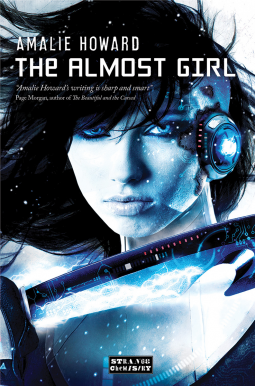
The Almost Girl Reviewed

From Chapter One, Amelie Howard's young-adult novel The Almost Girl effectively employs elements from the reader's own youth to give a familiar feel to an unusual teen's underslept, overscheduled life in a new school surrounded by people she neither knows nor understands in a world that has much bigger problems than the semester project she learns is half her physics grade. The disconnected teen we've known if not been becomes the building block for the reader's view into a coldhearted killer from another universe, sent here to blend with teens while evading military-designed fast-zombies – no, no, she says there are no zombies … but the commandos she used to lead before being given her secret mission are against her now and she must change gears rapidly from ninja warrior to vapid schoolchild as she tries not to lose her prize to other hunters.

Why To Read The Almost Girl

The strength of The Almost Girl is its use of what we already know to evoke our feelings. Who hasn't known tattling teacher's pets, naïve goodhearted victims, thuggish jocks, scowling and territorial popularity queens, and teens who notice with great force when an empty room has only a boy and a girl in it? The protagonist's alienness makes all the more credible her alone-ness, her separation from the rest of the world, the weight of what she's doing alone – things we've already sensed from the elements painted with the familiar experiences found in teen life. The fact the protagonist's stakes involve an inter-dimensional war and the life of a dying prince and so forth merely amplify and explain the anxieties and fears Howard paints with our own experience. Who hasn't seen – or been – a student called on the carpet before a teacher? Who hasn't been busted by a parent, smooching in a house thought to be empty? Come on, you at least came close. You've been there. You'll feel it, too.

You'll also feel the personal betrayal and guilt and pride and anger in the various relationships Howard provides with siblings, acquaintances, your best friend, incomprehensible parental figures, and seemingly everything else you did and knew as a teen.  Howard leverages this to great effect, so we feel the peculiar fear of being identified, caught, and punished each time we're led into another episode that echoes in our own lives.  Howard depicts relationships and interpersonal tensions with great mastery.  The author gently pulls the curtain on certain scenes before they go too far for a YA audience, or else fuzzes the camera so we don't get detail you couldn't notice through frosted glass, but this does nothing to impair our view of the conflicts that drive the story.

Howard appears to understand completely that what makes a story work is the characters, their conflicts, and keeping the reader in sympathy with the plight of the protagonist. And make no mistake: this book is about the characters and their insecurities and triumphs in the face of shifting circumstances and relationships and allegiances. If the story closed on an unambiguous Happily Ever After, there might not be a sequel. But the narrator is ambitious and driven so, in a tragic tradition dating back thousands of years, risks the rewards she's fought to win in a bid to fulfill her sense of mission despite the apparently easy alternative of happy retirement.

To watch broken people try to make their way in the world, not knowing whom they can trust, is much more intriguing than many of the fairy-tale worlds assembled for book buyers. And it's exciting to read a yarn about people operating with limited information under pressure. It's easy to sympathize with the main characters. It's particularly delightful to find one's self liking so many of the characters who are in conflict with one another. The Almost Girl is a fun read, and the perspectives from which it draws are surely as accessible to those who are still struggling through their teen years as to those of us who see them only in a rear-view mirror.

Content Warning

It's a tradition at The Jaded Consumer to provide a content warning to readers who might be set off by contact with some pet peeve that might not be revealed in a cursory overview or a read of the back-cover copy.  Content warnings don't imply a book isn't a good read – but what book is for all people?  Eliza Crewe's Cracked was extremely hard to put down, though its review included a warning for people who want their urban fantasy without central, overt religious content of the sort that began bothering a small set of Jim Butcher's readers some years back once The Dresden Files got underway.  The review of Steven Brust's and Skyler White's The Incrementalists notes that readers unwilling to tolerate real-world political commentary in their fantasy might want to look into the authors' politics before delving in.  They're wonderful books, but like Neil Gaman's shirt says,  
de gustibus non est disputandum. (There's no accounting for taste; literally, "there's no argument about the hors d'oeuvres." The brain cross-section shirt really gives new life to the old quote.)  As with the review of The Incrementalists, effort is spent to prevent this section from consuming undue space.

The Almost Girl is a book is about people and their relationships and their conflicts.  It is not a book about technology or security.  If you are a hard-core sci-fi fan who expects to experience shakes if high-tech super-suits from another Universe turn out to use halogen lamps for external illumination, or you think you will be unable to read further if that civilization manufactures thermometers that show temperature measurement that make senses to those of us who grew up using the Fahrenheit scale, you may want to think carefully before upsetting yourself. If you're a military reader with unshakable convictions regarding sentry removal techniques or security procedures, you may need to take a chill pill before getting too far into The Almost Girl. The cover evokes a delightful cyberpunk vibe, and it may attract scifi readers with demanding expectations regarding the made-up gadgets and technologies that inevitably color such work, and it is to some of these folks to whom the warning is largely directed.

Unless your OCD is out of control, or you have a special peeve involving the above, you should enjoy the book juuuust fine.

Conclusion

The Almost Girl uses an impending inter-dimensional war – and the need to keep ahead of a dimension-shifting cadre of conscienceless fast-zombies in supersuits (but no, says the narrator, there's no such thing as zombies) – to raise the stakes on a plausible-feeling teen suffering otherwise ordinary-looking stresses involving boy/girl interactions and siblings and parents and classes and teachers.  There's lots of action, to be sure. But the best gem in The Almost Girl is the work we all have in life, to find a place for ourselves however crazy it gets.  Amelie Howard's world is just painted a little crazier than yours.  It's worth a visit.