Showing posts with label storm. Show all posts

Tuesday, June 1, 2010

And You Thought Your Potholes Were Bad

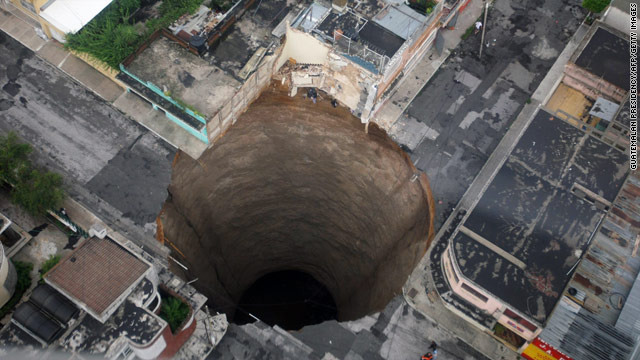
As you get further South, the cockroaches get worse, and apparently the potholes too. This specimen, developing in the wake of the tropical storm Agatha, was photographed in Guatemala:


115 died in Central America when the storm hit, and it'll be a long while repairing what isn't forever lost.

Saturday, September 27, 2008

Houston Getting Power

This week, about a quarter of Houstonians are still without power -- but more are getting power restored daily. Trucks from Pennsylvania and Connecticut have been spotted, and the estimate that ten thousand imported repair workers are in town is probably accurate. One power company, Entergy, boasts that all its Houston-area subscribers are back in power.

The M.D. Anderson Cancer Center offers an example of how this weather-related disaster can wreak havoc on institutions with no material physical losses. Anderson didn't lose power, both because it has generator backup and because the backup wasn't needed: the Texas Medical Center is supplied with power by buried cables, which weren't hit by falling trees. Centerpoint has some 14,500 steel transmission towers, and zero of them were destroyed. The power losses appear to have been caused almost exclusively by lines and connections being severed by falling trees. One wonders how much economic loss might be saved in the future by an investment in increased underground cabling.

Houston hasn't got a hotel shortage, but perhaps a third of the rooms are unavailable due to damage or simple absence of power. With FEMA having bought up all the remaining unoccupied hotel rooms, people coming to Houston for business have a hard time obtaining accommodations. Since a third of M.D. Anderson's patients are out-of-towners -- all of them paying customers, as opposed to storm-turfed nonpayers -- the institution has taken a substantial economic hit.

The problem of storm-turfed nonpayers (non-paying patients "turfed" to Anderson by institutions closing shop for the storm) is vexing because they aren't Texans qualified for coverage under state indigency programs (else their care would not be uncompensated), but are people that other branches of the University of Texas Health Science Center (coughGalveston'sUTMBcough) thought they'd treat on taxpayers' nickel, for fun, despite that they flew into town from other states or countries in order to pose as broke needy locals and are scamming them for free services. Yes, people fly into Houston from Iran and similar places for cancer treatment, and try to avoid paying a nickel for it. No, Texas legislators didn't think they'd opened a worldwide free medical clinic when they funded the University of Texas system during the last legislative cycle.

Some nitwit administrators don't know how to pronounce "no" or "fraud" and just let these folks walk all over them. Maybe they think pissing away taxpayers' money on people who not only don't qualify for indigent care but aren't even Texas or even U.S. taxpayers is somehow a worthy cause. My subtle take is this: being scammed isn't a virtue, and letting people scam you out of resources you are safeguarding for the public is lazy and corrupt.

Sometimes, it's people driving across the Texas border and pretending to be an American cousin to get coverage, and sometimes it's folks flying their known-sick relatives from other continents to the Texas Medical Center to foist them on local hospitals in the hope of winning the medical lottery. I hear someone in the distance crowing about universal health care, and the need for it, as if we should be happy to suffer this indignity. (Nevermind the only reason we now lack it is federal obstruction of state regulation to create universal coverage; let's hear the plea for federal single-payor care and try not to puke.) Even under a universal health care system as exists in Hawaii, Germany, Canada, or the UK you can't just fly into town and demand outrageously expensive treatments for the serious diseases you know you've got. The public feeling of entitlement to health care really creates problems in a place like the M.D. Anderson Cancer Center, where treatments for serious illness routinely cost six and seven figures to provide. The volume of patients at Anderson are quite a bit higher on a daily basis than the emergency rooms that are forced to give uncompensated care to folks who roll in on ambulances, so the losses mount faster. Suddenly absorbing unfunded fraudulent care cases from other branches of the U.T. system (because their administrators don't bother to do the work needed to weed them out) is a serious blow atop the sudden loss of so much regular paying work.

But back to the original point: Houston's power and infrastructure are getting back into shape. Folks with actual physical damage to their power connection to their homes are having the most trouble getting re-connected. I continue to encounter intersections whose traffic signals are dead or flashing, if not laying in the median in pieces.

The Mayor stated that the driveability of Houston roads was mostly restored by citizens responding to his call to take chainsaws and axes to felled trees blockading streets, and was mostly remedied in the first forty-eight hours following the storm. The existence of civil order in Houston appears to have been key to the relatively swift restoration of infrastructure to usability. The existence of a curfew order may have been useful to prevent property crimes, but the number of citations for curfew violation seems to support my thesis regarding the order: it was designed to amplify a show of force by police units, and not to be directly enforced. I strongly suspect selective application on the basis of subjective factors, but I anticipate that officers trained to avoid appearing to conduct profiling "needed" the curfew order as cover for what amounted to a profiling-based enforcement policy.

The intentional use of a curfew order as cover for arbitrary or oppressive enforcement would be very concerning. However, I suspect the order was intended not to support invidious discrimination but to provide cover for hard-to-quantify suspicions regarding vehicles and persons believed by officers not to appear engaged in innocent behavior. The intent of the persons creating the curfew -- that is, if they didn't intend it to be applied uniformly but only selectively against persons bearing undescribed characteristics that would lead police to want to stop and search them -- is a matter that deserves some thought in respect to legality and constitutionality, but that's not this post.

The Bolivar Peninsula appears to have been largely converted into a wasteland, and I expect in time the death toll from the storm will be revised upward as known or suspected non-evacuees are presumed dead.

Tuesday, September 23, 2008

Back in Houston

Houston is up and running. Tens of thousands still struggle without power, but I have seen utility vehicles from as far away as Connecticut working all day restoring utilities. Every day more get power.

The Mayor has decided that the city's landfills don't need to hold tons upon tons of trees, and has started buying wood chippers for the city. The city will have use of wood chips in the parks, and there may be commercial customers. Reduce, reuse, recycle.

I have no Internet connection. Actually, for the price of a Value Meal, I can use a connection at Chick Fil A while I guzzle lemonade (I'm still not sure about the water quality).

I have pics, and more notes on both the evacuation and the vehicle and the food and the iced tea, but these will have to wait until I have a steady connection at home.

More later!

Saturday, September 20, 2008

Heading Back to Houston

Now that half Houston has power and some of the grocery stores seem to operate nearly normally, I'm heading back home.

I don't have an Internet connection there because Comcast hasn't got its stuff together, so I may be out of touch for a while as I get situated and try to get back into business.

I have some half-finished posts I'm dying to get finished, but they'll have to wait.

See you soon!

Thursday, September 18, 2008

Houston at Ike+6

Houston remains a debris field, but more people are getting power restored. Restaurants able to serve customers -- I assume these are restaurants with gas grills, ovens, and stoves -- are doing a brisk business, so brisk in fact that to handle more customers they've in some cases produced special post-storm menus with limited range, so the kitchen can focus on churning out tons of food without having to worry about what people are ordering. At Papasito's on Richmond near Kirby, you can reportedly order three drinks: beer, frozen Margaritas, and water.

Eyewitness reports show that though my home is surrounded by people with functioning electrical power, I seem to have the wrong sort of luck for absentee power restoration: my place is still dark, and the fridge is going to need evacuation. According to CenterPoint Energy, my area sustained significant damage and isn't expected to have power restored until sometime after Monday, September 22.

Wednesday, September 17, 2008

Houston at Ike+5

Much of Houston is still without power -- and thus without television or an internet connection -- and the impact is visible.  

The still-lingering cold front makes it possible to go outdoors.  The relative improvement in inclination to walk (no power to pump fuel!) and spend time with neighbors (no TV to watch!) has made Houston for the time being a more hopping, social place than previously.  The comparison I heard to New Orleans wasn't based on storm damage, but conspicuous social activity.

The restaurants that are open -- I'm guessing here that gas stoves, ovens, and grills are the secret ingredient, perhaps next to wood-burning ovens and grills (mesquite bar-b-q?) -- are bustling even mid-week.

I'm trying to get a report on whether my place has power.  Houston Independent School District has announced school closures through Friday, but I've got a line on childcare help we can rely on in the event we have a prospect for electricity (hot showers).  The City of Houston says water testing shows no problematic bacteria, but they haven't discouraged ongoing antimocribial efforts like boiling water.

Firsthand reports from Houston say debris still abounds, particularly in the high-end River Oaks area, which had numerous mature, large trees to be split and obliterated by wind.  Power continues to be out in about half the city.  There is optimism of prompt power restoration in the city proper.

One friend, in the Northwast visiting an elderly relative, returned immediately after the storm despite the protests of his Galvestonian daughter who was living in his power-free home due to the storm, and was working in the Medical Center immediately thereafter.  The house has gas heat and ovens, so he's in better shape than many, despite ongoing absence of electricity.

I've noticed there are several posts here on Hurricane Ike, and it's likely in Houston that we'll get more storms, so I've created a weather tag.  This will allow me to distinguish posts on environmental policy issues from posts about immediate weather-related problems.  For some reason, getting posts by searching for the intersection of several tags doesn't seem to be supported by Blogger, so it's rough getting the exact post I want, sometimes.

If you have anything interesting on Ike or the weather, drop me a line.


Tuesday, September 16, 2008

North Texas at Ike+4

Today we set out to make lemonade.  

You know, from the lemons we got in the box that contained the power outages, school closings, difficulty retrieving work materials from a city over 300 miles away (well, using our decreased-traffic evacuation route, at any rate), cancelled jobs, lost earnings, and so on.

It turns out that the Houston Zoo has a reciprocity arrangement with the Dallas Aquarium, and L and I set out to check it out.  Funny thing, when you ask Google about the Dallas Aquarium, it tells you about an establishment called the Dallas World Aquarium which, though I'm sure it is very nice, is not the same place and doesn't have a reciprocity agreement and -- if you are sharp-eyed and have exact change and can get away with spending so little -- will require you to spend at least $2.50 trying to park during the week.  Granted, $2.50 is peanuts compared to downtown Houston, and certainly to anywhere space is genuinely precious, but it is irksome at any price to part with money, after fighting through all the places you might have change and end up overpaying just so you don't get towed, and then discover you're in the wrong place.

Let me tell you that the Dallas Aquarium has free parking.

The Mercedes E320CDI, which got us over 35 miles per gallon despite evacuation traffic and stops for food and traffic signals, is not to be trusted on how to find the Dallas Aquarium.  If you type in the street address and ask for directions, it'll surely lead you in the exact opposite direction from the Dallas World Aquarium and get you lost in Dallas, which is very easy to do. (Signs aren't marked here with the clarity of some places, and I've frequently gotten lost here on freeways though I'm virtually never lost in strange places unless I'm following the instructions of a navigator who's also lost.)  Google Maps, by contrast does a great job of identifying the spot.

This is a key reason Mercedes should ditch its lame navigation partner and provide an interface that can be driven by a docked iPhone.  Between Google Maps on iPhone and the impending TomTom application, people will be able to get maps with as much accuracy and recency as users care to obtain.  By contrast, I have pics I'll post on the performance of the built-in navigation system that will show you that it was full of BS the day it was delivered, and is only getting more inaccurate as time passes.  Bot more on that later.

The Dallas Aquarium isn't a big affair, but it's got some fun sights.  While we were there a Giant Pacific Octopus was fed a crab about a foot across.  You can tell the octopus is female because as it scrounges about looking for things, the third arm to the right of the mantle is as active as all the other arms, and isn't protecting this arm (which in males bears its reproductive organs) by holding it against its underside.

At least, you could tell this in the wild, supposedly, according to Sharon.  In the little enclosure the GPO had no trouble at all spotting its prey, and she darted to it, herded it against a wall, and put an end to the panicked flailing of its few visible appendages in virtually no time at all.  After a couple of moments, she took her kill to a spot against the wall of the tank near the top and started chomping away on the crab's exoskeleton to access all the edible little bots within, a process we learned would take over an hour.

The stone fish were fun to see.  When their eyes are closed, you have to be looking for a stone fish to see the fish.

The Dallas Aquarium has a couple of Giant Alligator Snapping Turtles, one of which is bigger than you are.  Eep!

The wierd exhibit occupant award has to go to a lobster whose leg-tips look like overgrown pipe cleaners, or baby-bottle brushes.  Highly colorful, it's got a shed (from molting) exoskeleton on exhibit in the breding lab window.  Huge dude.

The Dallas Aquarium also has air conditioning, by the way.  Did I mention the parking was free?

One thing the E-Class Mercedes' navigation system will reliably do is to give you directions back to a known-good destination from where you are located, provided the map it carries on a DVD includes the roads between the two destinations.  In Dallas, it seemed pretty good.  In Houston, construction has obsoleted lots of commonly-trafficked areas (say, I-610 anywhere near the Galleria).

If you drop in on the Texas State Fair -- the grounds of which house the Dallas Aquarium -- drop in and see the ginormous snapping turtle, the numerous stingrays, the pirhana, and the sea monkeys.  Yes, sea monkeys.  Did you know the sea monkeys advertised in the backs of those magazines aimed at kids are actually brine shrimp?  Now you know.

Houston After Ike

It turns out my place doesn't have power back on yet, so the first thing I do when I return will be to empty the refrigerator into a Dumpster.  

I'll have to time my return carefully, though, because the 9PM-6AM curfew is still in effect, and apparently enforced:  over a hundred ninety tickets were written for curfew violation the first night it was in effect.  

Houston Independent School District's inclement weather hotline says that the public schools will be closed through Wednesday, and a local tipster informs me that there's talk of keeping schools closed all week.  

Intersections controlled by lights are de facto 4-way stops.

All grocery stores reported to me (Randall's on Weslayan and anything near the Medical Center) are all selling only things that don't require refrigeration, except for Whole Foods on Kirby, which was selling fresh meat and dairy products -- all at normal prices -- and lines are heinous at any of them.

Lack of air conditioning will make the city miserable -- Houston is naturally a swamp, and except in winter tolerable only indoors -- the second the cold front fails.  However, Ike was immediately followed by a different storm, brought by the cold front that drove Ike East.  Houston is temporarily blessed with natural cool air.

Some folks, recognizing the finitude of their ability to keep perishables in their deep freezers, are throwing block parties for their neighbors so as not to lose the benefit of the vennison, ice cream, or other treasures that had been in cold storage.

Some restaurants (e.g., Luther's Bar-B-Q) were open Saturday -- Day Ike-1 -- and made good business feeding people who couldn't run their electric stoves.  Restaurants may have been without power, but those with gas heat have been working to sell perishables before they, you know, perish.  Ziggy's Grill on West Alabama was pushing turkey burgers this way, I understand.  Without electricity, keeping fed could become expensive.

I"ll be keeping tabs on the electricity.  Condominiums near the Greenway area are known to have power, as are many neightborhoods adjacent to the Medical Center.

If you visit friends for dinner in Houston, bring a toothbrush:  the curfew is 9PM, and you don't want a $500 citation.

Monday, September 15, 2008

Civil Order in Houston

Folks who followed the aftermath of Hurricane Katrina through Interdictor's blog are surely wondering how Houston's civil order is in the aftermath of Hurricane Ike. Unlike New Orleans, whose officers seemed to have dissolved in the face of disaster, Houston has regular patrols and a visible police presence.[1] 

My informants report spotting vehicles carrying teams of four male occupants, cruising in neighborhoods where they clearly had no personal connection, presumably casing the area. Identifying evacuated homes that might not have powered security systems, but would have good loot, probably seemed like a good plan to members of some professions. How will Houston moderate the risk of ill behavior under these circumstances?

Houston is under a curfew from 9PM to 6AM, so it's easier to spot night-time crooks. Under the curfew order, anybody spotted outdoors at the wrong time is a crook. Simplicity, no? Also, Houston didn't mostly evacuate. Sure, Houston is largely without power -- informants tell me fuel prices aren't up at all despite the storm, because there's no power with which to operate fuel pumps -- but this doesn't impact the inclination or ability to conduct home defense.[2] I don't expect a spike in violence in the storm's aftermath, as was observed in New Orleans, though I expect opportunistic property crimes to be a factor.

One reason to conclude as I have that civil order is likely to be maintained in Houston as compared to New Orleans is that civil order in New Orleans was largely a joke to begin with. New Orleans is famous for corruption, and abuse of office is a theme I've heard in numerous anecdotes from the city (even anecdotes intended to be funny, told by people who love the city). The police officers and prosecutors didn't create a cultural expectation of consequences for crime, so when crime targets presented themselves in large numbers in New Orleans, people inclined to behave poorly behaved really poorly.

To give you an idea of the cultural difference in expectation of consequences, let me lay out for you some of the things that surprised Katrina evacuees who, having been successful career criminals in New Orleans, attempted to continue their work in Texas. And yes, there were some Katricians (their word) committing crimes in Houston. Arresting officers were taken aback by criminals laughing at them for bothering to conduct an arrest, and were surprised to be taunted in sneering voices about how the arrestees would be walking free the next day. Or the same day. One shopkeeper interviewee explained it this way: "The locals care if you see them stealing; the evacuees don't." Houstonians' experience with the criminals who were part of the Karina evacuation was certainly an unpleasant surprise.

But the real surprise, it turned out, was on the part of the arrested folks. You see, they genuinely did not expect that (a) the police would expend the time and effort bring them to a processing center and jail them pending trial, (b) the Harris County prosecutors would actually perform the steps needed to have them formally charged, and appear in court as often as was required to move them toward trial or a plea deal, and (c) nobody was trying to game them into a payoff, they really wanted to convict and sentence suspected offenders. These things -- part of business as usual in local law enforcement here -- came as rather a shock to repeat offenders with rap sheets longer than you are tall, who were nevertheless still walking free when Katrina hit New Orleans. The idea that government employees might have enough work ethic to actually process a suspected offender, or work to charge and convict an accused criminal when there was no obvious political or financial benefit flowing from the particular case, was simply not on the mental map of people who'd lived all their lives committing crimes in New Orleans.[3]

New Orleans' civil order in the face of unashamed sociopaths was apparently a thin veneer put on to keep tourists (read: easy marks) from writing the place off completely. The fact that many of these not-really-committed citizens had bailed out of New Orleans without a plan to return was of great worry to government officials facing re-election by a committed minority who expected government to work as diligently on the city as they had to get their businesses back up and running. A year after the storm hit, Houston was barraged with campaign ads for New Orleans political candidates, targeting new Houston residents who departed New Orleans in teh face (or in the wake) of Katrina. The sponsors of these ads clearly hoped the ex-Louisiana residents could be persuaded to vote by absentee ballot or by special polling arrangement in a New Orleans election.

Mind you, the definition of citizenship in the United States -- and therefore voting eligibility -- is based on domicile. Your domicile can be retained in Houston if you go to Flower Mound until you are given official instructions that persons subject to the evacuation order are instructed to return, because you still have a fixed place of residence in Houston and a firm intent -- an intent with an ascertainable time -- for your return. This is why absentee ballots are still valid when you are doing a semester abroad: you have a domicile in the U.S., despite being gone, because you have a home to which to return and a known time you will return. The year-after campaign ads in Houston weren't targeting people who had a discernible time to return. These were people who had ignored official pleas for residents to come rebuild New Orleans, and were happier with their opportunities in Houston. (Except for the people with crime careers, who returned after figuring out that their standard of living was much better in New Orleans because of the reduction in occupational hazards associated with interaction with the criminal justice system. These guys largely figured out they weren't welcome and bailed. New Orleans is, from their point of view, once again the right place to do business.)

Now that I've established that Houston has some aspiring looters cruising the streets, through they are too timid to attempt crime while my informants are looking, I'm sure the next question is whether Houston will start gunning down minorities. Houston installed its first African American police chief in 1982 when it picked up Mr. Brown (later, Houston's first African American mayor) from his post as police commissioner from Atlanta. Its second African American police chief, Clarence Bradford, having served as police chief under two mayors, is now the democratic candidate for District Attorney (Judge Lykos, his Republican opponent, is a woman). Houston sits astride Harris County, which is a majority-minorty jurisdiction: less than half the population is "white".

This is to say: which group(s) should qualify in Houston as a minority?

Jokes aside, Houston took a turn a couple decades ago as a national leader in murders, and has turned itself around with vastly lower homicide numbers in the face of a greatly grown population. Houston's police patrols and response are clearly superior now to what existed in the 1980s, and the last time I was pulled over by a police officer I was given a citation because, I was told by the non-white officer, that they were keeping records of the races involved in traffic stops and since I was white he really had to give me a ticket. Apparently the course on discrimination law is an elective at the HPD Academy.  (I was pulled over for purportedly making a dangerous turn, which is funny, because I was trying to escape the danger posed by the ticketing officer as he barrelled down a 35 zone at about 80 on the way to a call.  If he was so hot to get to the call, why is he stopping to ticket people turning out of his way in fear to avoid being rear-ended?  Crazy.  In Texas you can generally disappear one ticket a year with defensive driving, so this kind of oddball interruption isn't as serious as it might otherwise be.)

Despite the great diversity in Houston's races and languages -- you can find street signs here in Chinese or Vietnamese if you go to the right parts of town -- we seem to get along pretty well. For a place as heavily armed as Houston, you'd expect more violence if we were prone to it.

The real problems facing Houston at present are:
  • Electricity Outages. The cold front is a blessing, the additional rain notwithstanding, but if power isn't back by the time the cool air is defeated by Houston's September, people will bake alive in their homes. Without electricity, fuel stations can't pump fuel. One station north of town was rationing fuel to people with containers to prevent immediate sellout, and it had enormous lines. So far, people don't seem to be out of fuel, just the electricity to pump it. Until electricity is back, evacuated residents should stay away, which means the curfew will continue to prevent property losses.
  • Groceries. Grocery stores, like everyone else, need things like power (lights? refrigerators? cash registers?). I have reports from two stores that are out of numerous things but still have huge lines for entry. Fresh fruits and vegetables require frequent restocking, and dairy requires refrigeration. This is going to be a problem unless restocking becomes plausible.
  • Busted Stuff.  All this junk must go somewhere, and Houston isn't Camelot -- unwanted bits laying about don't all blow away completely, at night (of course).  Debris is an impediment to rebuilding, and it will keep lots of inundated downtown offices from being restored to working order any time soon.  A roof doesn't work if it leaks, and no building is habitable (at least in Houston) unless it can resist rainfall.  Downtown law firms with soaked and scattered papers, and computers that all now enjoy liquid cooling?  Let's hope you've got work-stoppage insurance and off-site backup.

[1] Houston also has nontrivial military presence, which ordinarily doesn't come to anyone's attention because it ordinarily doesn't mass in public. There are, for example, reservist units based in Houston that meet and train and muster for exercises, but my chief interaction with them was on the weekends when tending a Houston grocery store cash register as a high-schooler -- they'd send a couple of folks to load up on refreshments and donuts to keep the weekend warriors sustained. I can't get my pics uploaded from here, but before I bugged out I photographed a line of military vehicles, their storage areas filled with liquid containers, lining up to be in place to offer support following the storm. Whether the containers were fuel or water or both wasn't something I discerned walking past.

[2] Home defense actually means something in Harris County. Unlike some jursdictions, Harris County is very receptive to homicide defenses based on deliberate acts to protect third parties or their property. Failure of a criminal charge can occur through a grand jury's disinclination to indict, or through a prosecutor's disinclination even to bring the charge to the grand jury. As for being armed to defend one's home ... I read in the 1980s that Harris County had more firearms in it than the combined arsenals of the then-warring nations of Iran and Iraq. Mind you, I have been informed that automatic weapons and rocket-propelled grenade launchers and their ammunition are as easily obtained in Iraq as are matchbooks in the United States, so I retain a certain skepticism about the relative firearms count.  We have a lot of matchbooks.

[3] Mind you, the people who lived all their lives in New Orleans not committing crimes were probably happy someone finally began doing something to get the garbage off the streets. I know some New Orleans people myself, and I love 'em. Indeed, it was these New Orleans friends who warned me that they didn't leave New Orleans to become the neighbor of a relocated Ninth Ward. It's these folks, the ones who act like they've bought off the whole government already and are entitled to everything they can steal and are offended they aren't getting even better handouts than they've received, that get my eyes rolling. And for you non-evil New Orleanders, here and everywhere: laisses les bons temps rouler!
Saturday, September 13, 2008

The Effectiveness of Preparedness

On Thursday, when hurricane Ike was thought likely to make landfall in Texas as a class three or stronger, its predicted impact included a Galveston Island storm surge of twenty feet or more. The National Weather Service issued a strongly-worded warning for coastal areas of Texas, and urged evacuation.

A storm similar to Ike's predicted power had hit Galveston square-on before, in 1900. During that storm, locals did not evacuate but had actually gathered on the beach to observe the waves. The only non-marine egress from the island at the time was "the longest wagon bridge in the United States" and there was no manmade storm surge barrier on the island. Six thousand are known to have died in Galveston's storm of 1900, and the complete count of the dead is thought likely between eight and twelve thousand. Thousands more were injured, and approximately ten thousand left homeless.

According to the United States Census of 1900, the population of the United States stood just under 76 million inhabitants. The loss of eight thousand (the number offered by the National Oceanic and Atmospheric Administration) amounts to about one hundredth of one percent of the national population. During the census year ended in May, 1900, the annual death count was about a million and a half, suggesting that the loss of 8,000 souls contributed about a half a percent the then-current all-causes annual death toll. On the other hand, understanding the scale of the disaster may be aided by considering that the Texas death toll in the 1900 census was less than one hundred thousand, and that the population of Galveston was less than twenty thousand. (Today, the population is sixty thousand.) If you are nearby, it looks terrible indeed.

The construction of fifteen-foot storm barriers against the encroaching ocean contributed to Galveston's improved outcome when it later faced a similar storm surge:
In 1915, a storm of similar strength and track to the 1900 hurricane struck Galveston. The 1915 storm brought a 12 foot (4 m) storm surge which tested the new seawall. Although 275 people lost their lives in the 1915 storm, this was a great reduction from the thousands that died in 1900.
from Economist's View
Today, storm surveillance and still-developing emergency-response strategies have enabled the hurricane death count to be controlled to a mere four. Granted, uncooperative non-evacuees peppered emergency numbers all night with futile pleas for evacuation, and more might have been killed on Galveston had the storm surge hit those choosing to remain with the predicted twenty-foot-plus surge rather than the surge that materialized. However, people who choose to ignore a plea for evacuation like this take their lives in their own hands. It's not the same as breaking into a junkyard to taunt hunger-maddened dogs while wearing a cat costume to win a home video competition, but it's not far behind. The four and a half million without electricity will eventually get power restored, including the sixty thousand on Galveston.

Unlike freak acts of nature that might or might not strike, known sources of human-caused risk create an evergreen source of mortality, morbidity, and property damage. For example, accidental drownings in recreational environments aren't a result of the weather or unavoidable astronomic phenomenon such as meteor strikes, and they routinely kill thousands of Americans annually. The Centers for Disease Control and Prevention -- the "Prevention" was added to the CDC's name recently enough that the agency is still called the CDC -- has a special page devoted to drowning risk. Accidental drowning in recreational environments is such a significant cause of death that -- despite widespread laws requiring home pools to be fenced, swimming training programs, and laws ensuring boater access to life vests -- recreational drownings eclipsed terrorist attacks as a leading cause of mortality even in the year of the high-water mark of terrorist attack fatalities in the United States. One wonders how much worse drownings could be, but for the effort to control its toll.

One way to illuminate the effectiveness of preparedness is to look at the progress the United States has demonstrated against another manmade mortality risk: driving-related fatality. During the 1980s, the approximately-fifty-thousand annual death toll from driving-related incidents in the United States challenged the country's cumulative death toll of the entire Vietnam war. Despite increasing numbers of drivers and increasing numbers of miles driven, efforts to control risk -- including interventions like mandatory seat belt laws, education on driving risk, and the implementation of widespread designated driver promotion programs -- have decreased the absolute number of annual deaths. The rate has plummeted even more. (It turns out that alcohol is a nontrivial contributor to drowning fatality risk, too.)

Risk-control interventions significantly impact materializing losses. The question is whether the results are worth their human and financial cost. In the case of avoided drownings and avoided road deaths, it's easy and politically non-controversial to conclude that prevention is money well-spent.

The question is how to develop a policy analysis framework with the power to address situations in which political views heavily color viewpoints.